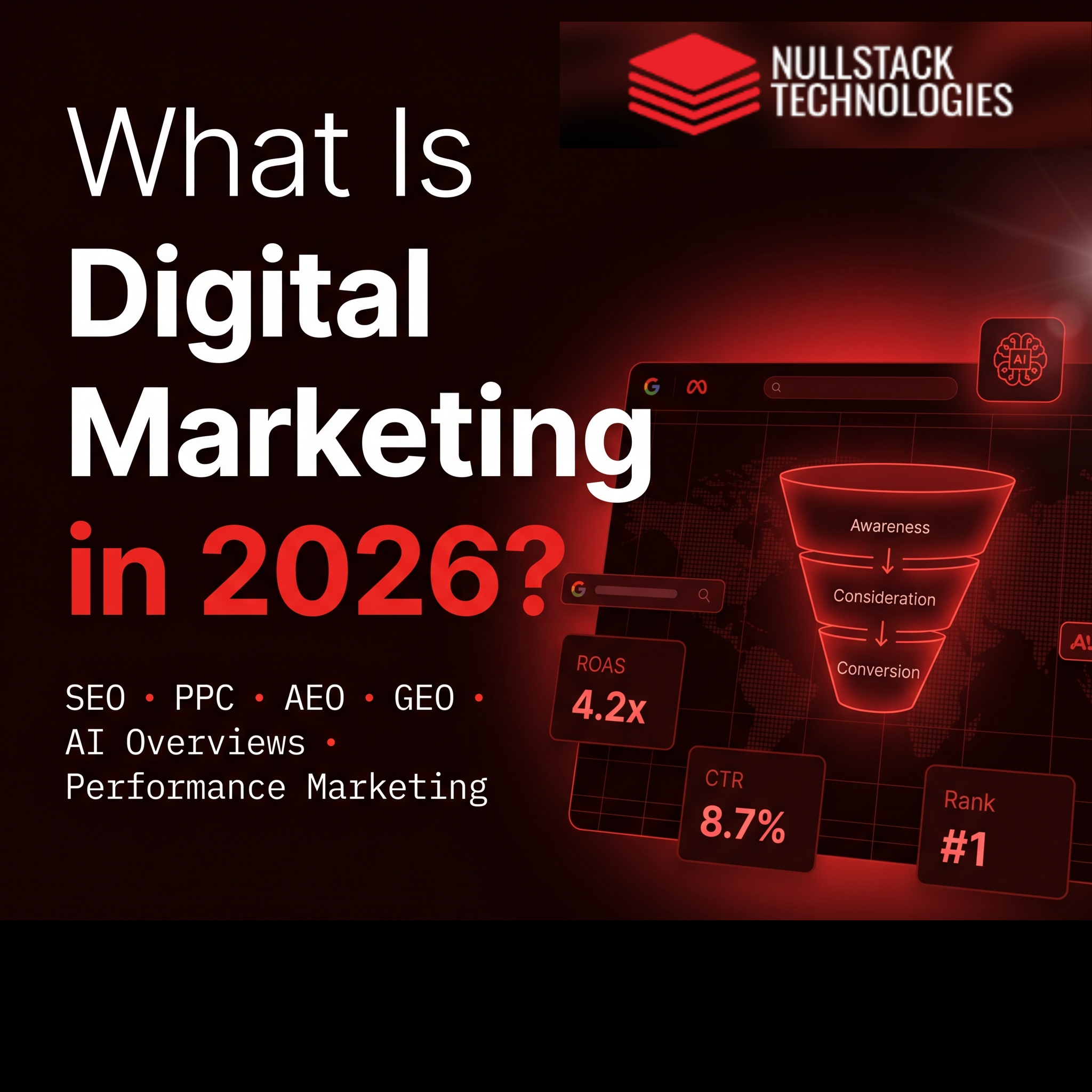
Quick Answer: Digital marketing is the promotion of brands using the internet and other digital channels. It helps businesses target specific audiences, measure performance accurately, and engage customers throughout their buying journey.
In 2026, it extends beyond traditional performance channels to include Answer Engine Optimisation (AEO) and Generative Engine Optimisation (GEO), which secure brand visibility inside AI-generated responses from Google AI Overview, ChatGPT, Gemini, and Perplexity. Every channel is measurable, every decision is data-driven, and every campaign is attributable to a business outcome.
What Is Digital Marketing?
Digital marketing is any marketing activity that uses a digital channel to reach, engage, and convert a defined audience.
Traditional marketing: print, television, outdoor, radio and operates on impressions and recall. It reaches a broad audience, measures success in proxies, and makes attribution guesswork. Digital marketing operates on measurement. Every click, every session, every conversion is logged. You know exactly which campaign produced which outcome, at what cost, and at what margin.
That measurability is the core difference and not the channels themselves. A banner ad on a website is not digital marketing if nobody is tracking what happens after the click. A WhatsApp message sent to a segmented lead list, with a UTM-tagged landing page and a CRM integration, absolutely is.
The four disciplines that define modern digital marketing
- Acquisition: getting the right people to your website or landing page through organic search, paid ads, social media, email, or referral.
- Conversion: turning visitors into leads or customers through compelling offers, landing-page design, and persuasion architecture.
- Retention: keeping customers engaged and buying again through lifecycle email, loyalty programmes, and community building.
- Attribution: connecting every marketing touch to a revenue outcome so budget flows toward what actually works.
In 2026, a fifth discipline has become non-negotiable: AI-surface visibility: making your brand discoverable inside AI-generated answers, not just blue-link rankings.
If you are running a business in India and want to understand what full-service digital marketing looks like in practice, our digital marketing services page covers every channel we run and how they connect into a single measurement system.
Why Digital Marketing Matters More in 2026 Than Ever Before
In 2026, the average Indian internet user spends more than 7 hours online per day, and over 65% of all purchase decisions i.e B2C and B2B begin with a digital search.
Several macro shifts have made digital marketing more critical, and more complex, than it was even two years ago.
The AI Overview disruption
Google’s AI Overview now generates direct answers for an estimated 20 to 30 percent of all search queries. For these queries, users often get what they need without clicking any result. Organic traffic for information-heavy keywords has fallen on pages that were never built to be cited by AI and brands that have invested in AEO are filling the gap.
Third-party cookie deprecation
The phase-out of third-party cookies across Chrome and Safari has shattered traditional cross-site attribution. Marketers who relied on platform-reported ROAS without server-side verification are now flying partially blind. First-party data strategy and server-side tracking have moved from advanced practice to table stakes.
India’s digital economy is scaling fast
India’s digital advertising market crossed INR 50,000 crore in 2025 and is growing at roughly 15 percent annually. Mobile-first behaviour, UPI-powered commerce, and a 900-million-plus internet user base have created a digital marketing opportunity that dwarfs most comparable markets globally. The brands that invest in digital infrastructure now are building moats that will compound for the next decade.
The buyer is more informed, more sceptical, more ad-aware
Gen Z buyers research more deeply, trust influencer content selectively, and skip ads instinctively. Performance marketing alone no longer closes the gap. The brands winning in 2026 are combining performance with proof i.e SEO content that answers real questions, case studies that show real outcomes, and review signals that build real trust.
What Is SEO (Search Engine Optimisation)?
Search Engine Optimisation is the practice of improving a website’s visibility in organic (unpaid) search engine results so that the right audience finds it when searching for relevant products, services, or information.
Search engines rank pages by evaluating hundreds of signals across three broad categories: technical quality, content relevance, and external authority. SEO is the discipline of optimising all three in a coordinated way.
The four pillars of SEO
| Pillar | What it covers | Why it matters |
|---|---|---|
| Technical SEO | Crawlability, indexation, page speed, Core Web Vitals, schema markup, JavaScript rendering, canonical strategy | Google/ Search Engines cannot rank what it cannot read. Technical issues are the most common hidden cause of ranking failures. |
| On-Page SEO | Title tags, meta descriptions, header hierarchy, keyword placement, semantic content depth, internal linking | Tells search engines exactly what the page is about and confirms relevance to the user’s query. |
| Off-Page SEO | Backlink acquisition, digital PR, brand mentions, entity citations | External links and mentions transfer authority and trust. Topically relevant backlinks are the strongest external ranking signal. |
| Local SEO | Google Business Profile, citation building, review velocity, local schema, geo-targeted content | Critical for businesses serving a geographic market. Local pack visibility captures 30%+ of local-intent clicks. |
SEO in Recent Times: entity-first, E-E-A-T-driven
Modern SEO requires your brand to exist as a recognised entity in Google’s Knowledge Graph — not just as a keyword target. Google’s E-E-A-T framework (Experience, Expertise, Authoritativeness, Trustworthiness) has elevated the bar for content quality. Pages written by named experts, citing verifiable experience, with demonstrable authority signals, consistently outrank anonymous content regardless of keyword density.
Ranking timelines are honest: technical fixes show improvement in 4 to 8 weeks; competitive keyword rankings materialise between months 3 and 6; compounding authority builds through months 6 to 18. Anyone promising first-page rankings in 30 days is not describing SEO.
What Is SEM and PPC Advertising?
SEM (Search Engine Marketing) is the use of paid advertising on search engines primarily Google Ads and Microsoft Ads to place your brand in front of users at the exact moment they search for what you sell. PPC (Pay-Per-Click) is the billing model: you pay only when a user clicks your ad.
Where SEO earns traffic over months, SEM buys it immediately. Both are necessary; they answer different questions at different points in your business lifecycle.
How Google Ads works in 2026
Google Ads runs on an auction. Every time a user searches, Google runs a real-time auction among eligible advertisers. The winner is determined not by who bids highest, but by Ad Rank: a composite of bid, Quality Score (expected CTR, ad relevance, landing-page experience), and auction-time signals including device, location, and user context.
In 2026, Google’s Smart Bidding algorithms: Target CPA, Target ROAS, and Maximise Conversions which dominate campaign management. Most D2C indian business go with Google’s Performance Max Campaigns for there strategy. These algorithms require clean, complete conversion data to optimise toward. Campaigns fed by browser-only tracking miss 30 to 45 percent of conversions on iOS and ad-blocker traffic, causing the algorithm to under-bid for high-value users and over-bid for low-value ones. Server-side conversion tracking directly corrects this and it is why campaigns with server-side tracking consistently outperform equivalent campaigns without it.
Campaign types you need to understand
- Search campaigns: text ads triggered by keyword queries. Highest purchase intent of any ad format.
- Performance Max: Google’s all-channel campaign format. Uses machine learning across Search, Display, YouTube, Gmail, and Maps. Requires strong asset inputs and clean conversion data to perform.
- Shopping campaigns: product-listing ads with image, price, and title. Essential for e-commerce. Feeds from Google Merchant Center.
- Display and Discovery: visual placements across Google’s network. Best for retargeting and upper-funnel awareness.
What Is Performance Marketing and How Is ROAS Measured?
Performance marketing is a results-based advertising model where advertisers pay only for specific, measurable outcomes i.e clicks, leads, app installs, or sales rather than for impressions or exposure.
It encompasses paid search, paid social, affiliate marketing, and programmatic display: any paid channel where the billing or budget allocation is tied directly to a conversion event.The Indian digital advertising market / digital marketing spend crossed INR 50,000 crore in 2025
and is growing at 15% annually but aggregate numbers hide the
variance that matters for campaign planning. Here is what real
performance looks like across the segments we run campaigns in.
ROAS: the core formula and its limits
ROAS = Revenue Generated / Ad Spend
A campaign that generates INR 4,00,000 in revenue on INR 1,00,000 in ad spend has a 4x ROAS. This is the headline metric. But it is also incomplete on its own.
| Metric | What it tells you | What it misses |
|---|---|---|
| ROAS | Revenue per rupee of ad spend | Gross margin, fulfilment costs, customer LTV |
| Blended ROAS | Total revenue / total ad spend across all channels | Which specific channel drove which conversion |
| MER (Marketing Efficiency Ratio) | Total revenue / total marketing spend (all channels) | Individual channel performance |
| CAC (Customer Acquisition Cost) | Total spend to acquire one customer | Whether that customer is worth acquiring (LTV ratio) |
The best-performing performance marketing programmes in 2026 report on all four. ROAS alone gets gamed. CAC:LTV ratio is the number that determines whether the business model is sustainable.
Attribution: the unsolved problem performance marketing lives inside
Digital Marketing is closely tied up to Attribution. A customer sees your Instagram ad on Tuesday, Googles your brand name on Thursday, and converts via a Google Search ad on Friday. Last-click attribution credits the Search ad with 100 percent of the revenue. Data-driven attribution distributes credit across all three touches proportionally. The difference in budget decisions between these two models is significant, often 20 to 40 percent of total spend being misallocated. Behavioral Analytics is also a good way to explain certain dashboard actions like “users who watched two product videos within 48 hours of first visit mostly converted”.
The answer is not a better attribution model in isolation rather it is cleaner measurement infrastructure: server-side tracking, GA4 with proper conversion modelling, and a CRM that closes the loop between marketing touch and actual revenue.
What Is Google Business Profile (GMB) Optimisation?
Google Business Profile (GBP) optimisation is the process of building, maintaining, and improving a business’s free listing on Google Maps and the Google local search pack so that it ranks highly for relevant local queries and converts searchers into customers.
For any business serving a specific geography: a clinic, a restaurant, a law firm, a real estate developer, a retail outlet: GBP is the single highest-ROI digital asset they own. The local pack occupies the most valuable real estate on the search results page, and it is free to appear in.
The five signals that drive local pack rankings
- Relevance: how well your GBP categories and description match the user’s query.
- Distance: proximity of your listed address to the user’s location at search time.
- Prominence: how well-known and trusted your business is, based on reviews, citations, backlinks, and engagement signals.
- Review velocity: the pace at which you are earning new, genuine Google reviews. A fresh stream of reviews outperforms a large historical count that has gone stale.
- Profile completeness: businesses with complete GBP profiles — photos, services, Q&A, posts, hours, attributes consistently rank above incomplete profiles with equal proximity.
For Kolkata-based businesses competing for local search visibility, our digital marketing services in Kolkata include GBP optimisation, citation building across 40+ Indian directories, and review-velocity programmes: all tracked via local rank-grid reporting rather than a single-point search.
GBP and AI Overview: an underused connection
Google AI Overview in Digital Marketing increasingly pulls business-information answers from GBP data. A well-structured GBP with accurate service descriptions, populated Q&A, and consistent NAP (Name, Address, Phone) signals across directories is increasingly becoming a prerequisite for local AI-answer visibility — not just map-pack ranking.
What Is Social Media Marketing?
Social media marketing is the use of social platforms: Meta (Facebook and Instagram), LinkedIn, YouTube, X (formerly Twitter), and emerging platforms to build brand awareness, get attention and engage an audience, and drive measurable business outcomes through both organic content and paid advertising. Curiously, for some individuals and companies in India, Social Media Marketing == Digital Marketing.
Organic social and paid social are two distinct disciplines that are often conflated and should not be.
Organic social vs paid social
| Dimension | Organic Social | Paid Social |
|---|---|---|
| Cost | Time and content production | Ad spend plus creative production |
| Reach | Existing followers (typically 2-5% organic reach on Meta) | Precisely targeted audiences beyond your follower base |
| Speed | Compounds slowly over months and years | Delivers traffic and leads immediately |
| Measurement | Engagement, reach, follower growth | CTR, CPL, ROAS, CAC — hard business metrics |
| Primary role in 2026 | Trust, community, brand warmth | Acquisition, retargeting, product discovery |
Platform selection in 2026
The right platform is where your buyer spends deliberate time, not just scrolling time. B2B SaaS and professional services belong on LinkedIn. D2C fashion, beauty, and food brands belong on Instagram and YouTube Shorts. Real estate developers need Meta’s hyperlocal targeting. EdTech brands are finding YouTube to be the highest-converting channel for course discovery. The mistake is spreading across every platform and executing none well.
What Is Content Marketing?
Content marketing is the practice of creating and distributing genuinely useful, search-intent-matched content: articles, videos, guides, original data reports, case studies, and tools — to attract a defined audience, build topical authority, and convert that audience into customers over time.
The word “useful” is load-bearing. Content that exists to fill space, inflate word count, or repeat what competitors have already said does not rank, does not convert, and does not earn backlinks. The bar in 2026 is original thinking or original data, structured to answer a real question better than anything else that exists on that topic.
The pillar-cluster architecture
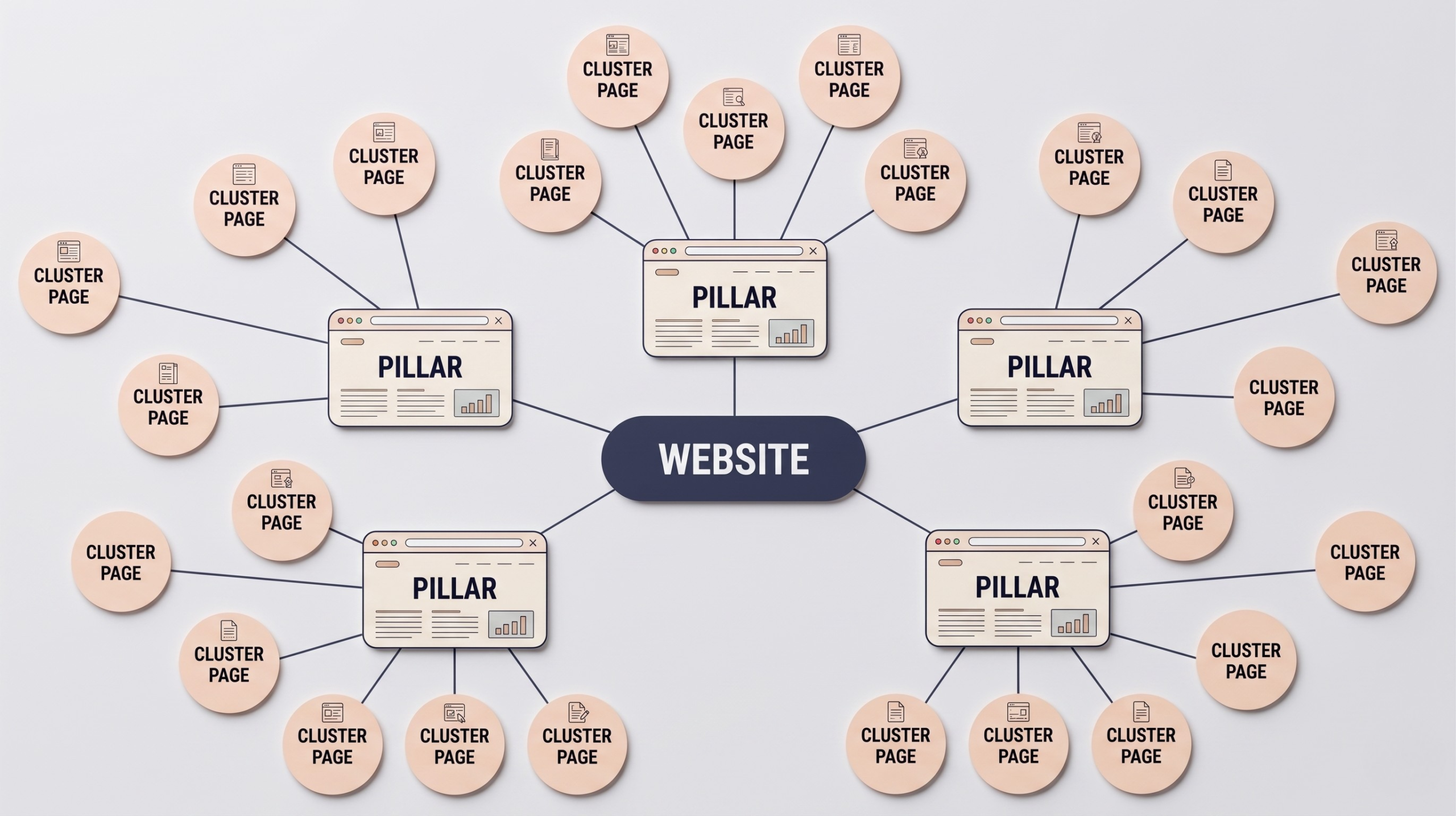
A pillar page (like this one) covers a broad topic comprehensively and acts as the internal linking hub for a cluster of more specific articles. The pillar article on “what is digital marketing” internally links to cluster articles on “what is SEO,” “how to set up Google Ads,” “how to calculate ROAS,” and so on. The internal links pass authority downward; the cluster articles’ topical depth passes authority back upward. Google rewards this structure because it signals genuine expertise across a topic, not isolated page optimisation.
Why original data earns compounding backlinks
Journalists, bloggers, and other brands link to sources they cite. A content piece that contains a proprietary survey, a unique data analysis, or an original framework becomes a citation target. A single well-placed article containing original research can earn dozens of editorial backlinks with zero outreach. This is the most efficient backlink strategy that exists — and it is also content that AI engines prefer to cite.
What Is Email Marketing and Automation?
Email marketing is the practice of sending targeted, permission-based messages to a list of subscribers or customers to inform, nurture, and convert them and email automation is the process of triggering those messages based on user behaviour rather than on a calendar.
Email consistently delivers the highest ROI of any digital marketing channel: industry estimates place the average return at INR 3,000 to INR 3,500 for every INR 100 spent: roughly 30 to 35x. The reason is that email reaches an audience that has already given you permission, which is qualitatively different from every other channel.
The four email flows every business needs
- Welcome sequence: the first 3 to 5 emails after sign-up. Sets expectations, delivers the promised lead magnet, and begins to establish trust.
- Lead nurture flow: a behavioural sequence triggered by content consumption. Moves a prospect from awareness to consideration without requiring manual follow-up.
- Abandoned cart recovery: for e-commerce, an automated sequence triggered when a user adds to cart but does not purchase. Typically recovers 5 to 15 percent of abandoned sessions.
- Win-back campaign: a re-engagement sequence for subscribers or customers who have gone silent. Protects list deliverability and reactivates latent revenue.
Deliverability: the part most teams ignore
An email that never reaches the inbox earns nothing. Deliverability depends on sender reputation (domain age, email authentication: SPF, DKIM, DMARC), list hygiene (removing hard bounces and chronic non-openers), and engagement signals. Platforms like Klaviyo, HubSpot, and Mailchimp surface deliverability metrics, but they require active monitoring — not set-and-forget.
The AI Overhaul: AEO, GEO, and the End of Blue-Link Dominance
The most significant structural shift in digital marketing in 2026 is the fragmentation of search: queries that used to send users to ten blue links are now being answered directly by AI: inside Google AI Overview, ChatGPT, Gemini, and Perplexity without requiring the user to click anywhere.
Two new disciplines have emerged to address this shift. They are not replacements for SEO and PPC. They are layers that sit on top of the existing channel stack and determine whether your brand is mentioned when AI generates its answer.
What is AEO (Answer Engine Optimisation)?
AEO is the discipline of optimising content so that AI answer engines including Google AI Overview, ChatGPT Search, Gemini, and Perplexity extract, cite, and recommend your brand in their generated responses.
AEO requires four things that traditional SEO does not always address:
- Entity clarity: your brand must be a recognised entity in structured databases and knowledge graphs, not just a keyword-dense webpage.
- Q&A content structure: AI engines parse content for direct, answerable structures. Pages with clear question-and-answer formatting, semantic completeness, and concise definitions are cited more frequently.
- Schema depth: Article, HowTo, FAQ, and Author schema with proper entity relationships increase the probability of AI extraction.
- Citation readiness: content written in authoritative, third-person, factual language is preferred by AI over promotional copy.
What is GEO (Generative Engine Optimisation)?
GEO is the practice of optimising your brand’s presence in generative AI outputs making your business name, products, or expertise appear as recommended options when AI models generate answers, comparisons, or product recommendations.
Where AEO focuses on getting cited inside AI answers to specific questions, GEO focuses on becoming the brand that AI recommends when a user asks for options. “What is the best digital marketing agency in Kolkata?” asked to Perplexity is a GEO challenge. The answer depends on brand mentions across authoritative web content, structured data consistency, and editorial citations — not on a paid ad or a traditional ranking.
SEO vs AEO vs GEO: a comparison
| Dimension | SEO | AEO | GEO |
|---|---|---|---|
| Platform | Google, Bing (blue links) | Google AI Overview, Perplexity, ChatGPT Search | ChatGPT, Gemini, Perplexity, Claude, Copilot |
| Goal | Rank in organic results | Get cited in AI-generated answers | Get recommended in AI-generated outputs |
| Success metric | Ranking position, organic traffic | AI citation frequency, answer surface impressions | Brand mention rate in AI outputs for target queries |
| Primary inputs | Technical quality, content relevance, backlinks | Entity signals, Q&A structure, schema depth | Authoritative brand mentions, structured entity data, editorial citations |
| Timeline | 3 to 18 months | 2 to 6 months | 6 to 18 months |
| Kills you if ignored | Poor technical foundation | Anonymous, unstructured content | Zero brand presence in authoritative sources |
The brands that win the AI-search era are not the ones that optimise for one of these three in isolation. They are the ones that treat SEO, AEO, and GEO as a single integrated strategy — with a measurement system that tracks visibility across all three surfaces simultaneously.
How to Approach Digital Marketing in the AI Era: 5 Strategic Principles
The AI era has not replaced the fundamentals of digital marketing. It has added new surfaces, new measurement challenges, and higher stakes for brands that ignore them. These five principles hold across every industry and every channel mix.
Principle 1: Measure Everything, Attribute Nothing to Feeling
Every campaign, every content piece, every channel needs a defined conversion goal before it launches, not after. “We got some enquiries” is not a result. “Our SEO programme generated 48 qualified leads in month 6 at an organic CAC 25% below our paid CAC” is a result. The measurement infrastructure: server-side tracking, GA4 with proper conversion modelling, Looker Studio dashboards, CRM integration should exist before the first campaign goes live. If your current setup cannot produce that sentence, fix the measurement before you scale the spend.
Principle 2: Build for AI Surfaces, Not Just Blue Links
Your content strategy for 2026 cannot be “write blogs for Google.” It has to be “write content that earns citations in AI answers, ranks in blue-link results, and builds entity recognition across the knowledge graph simultaneously.” These goals are largely overlapping, but the execution differences matter: structured Q&A formatting, explicit author attribution, schema depth, and factual citation-readiness are all required for AI surfaces and are not automatically produced by traditional blog content.
Principle 3: Invest in Owned Channels Alongside Rented Ones
Paid channels (Google Ads, Meta, LinkedIn) rent you an audience. The day you stop paying, the audience disappears. SEO, content, email, and brand search build owned assets that compound over time and reduce dependence on rising ad costs. A mature digital marketing programme has a healthy ratio of owned to rented acquisition and that ratio improves year over year as organic and email channels mature. Building exclusively on paid channels is efficient today and fragile tomorrow.
Principle 4: Creative Is a Variable, Not a Constant
In paid social and increasingly in SEO and content, creative quality determines performance as much as targeting, bidding, or keyword selection. The discipline is not “make great creative.” It is “test creative systematically, measure the signal, kill what loses, and scale what wins.” Agencies and in-house teams that treat creative as a production task rather than a performance variable leave significant ROAS on the table. Every campaign should have at minimum three creative variants in rotation and a defined testing cadence.
Principle 5: Match Your Channel Mix to Your Business Lifecycle Stage
The right digital marketing strategy for a 6-month-old D2C brand is not the same as the right strategy for a 7-year-old B2B SaaS company. Early-stage businesses need fast feedback loops: paid social and PPC validate demand, test positioning, and generate the first hundred customers. Growth-stage businesses need compounding infrastructure: SEO, content, email lifecycle, and attribution maturity. Scale-stage businesses need efficiency: automation, programmatic, and AI-surface visibility to reduce CAC as competition intensifies. Matching the channel mix to the stage is the most consequential strategic decision in digital marketing and the most frequently ignored.
For B2B tech, startup, and enterprise brands in the south Indian market, our digital marketing services in Bangalore cover the full channel stack — from technical SEO and LinkedIn lead generation to server-side attribution and AEO — with a dedicated team that reports in data, not decks.
Digital Marketing Glossary: 39 Terms Every Marketer Must Know
This glossary covers every core term in digital marketing: from foundational concepts to AI-era disciplines, with definitions precise enough to quote in a brief, a board meeting, or a vendor evaluation.
- A/B Testing
- A controlled experiment that compares two versions of a variable (ad copy, landing page, email subject line) to determine which produces better results against a defined metric.
- AEO (Answer Engine Optimisation)
- The discipline of optimising content to be extracted, cited, and recommended inside AI-generated answers from Google AI Overview, ChatGPT, Gemini, and Perplexity.
- Algorithm
- A set of automated rules used by search engines and social platforms to determine which content to show, to whom, and in what order.
- Attribution Model
- A rule or data-driven framework that assigns credit for a conversion to one or more marketing touchpoints in the user journey. Common models: last-click, first-click, linear, time-decay, data-driven.
- Backlink
- A hyperlink from one website pointing to another. Backlinks from topically relevant, high-authority domains are the strongest external signal for organic ranking.
- Bounce Rate
- In GA4, the percentage of sessions that are “non-engaged” — defined as sessions shorter than 10 seconds with no conversion event and no second page view. A high bounce rate on a landing page typically indicates a mismatch between ad promise and page content.
- CAC (Customer Acquisition Cost)
- Total marketing and sales spend divided by the number of new customers acquired in the same period. The single most important efficiency metric in performance marketing.
- Call-to-Action (CTA)
- A prompt — button, link, or phrase — that directs the user toward a desired next step: “Book a free audit,” “Download the guide,” “Get a quote.”
- Click-Through Rate (CTR)
- The percentage of users who click after seeing an impression. Calculated as clicks divided by impressions. A low CTR on a high-ranking page signals that the title tag or meta description is under-performing.
- Content Marketing
- The creation and distribution of useful, search-intent-matched content to attract a defined audience, build topical authority, and convert that audience into customers over time.
- Conversion Rate
- The percentage of visitors who complete a defined action (form submission, purchase, call). Conversion rate = conversions divided by sessions. A 1% e-commerce conversion rate is typical; a 3%+ rate is strong.
- CPC (Cost Per Click)
- The average amount paid each time a user clicks a paid ad. Calculated as total ad spend divided by total clicks.
- CPL (Cost Per Lead)
- Total ad spend divided by the number of leads generated. The preferred efficiency metric for B2B and lead-generation campaigns over ROAS, which is more relevant for direct e-commerce.
- CRM (Customer Relationship Management)
- A software platform that stores and manages customer and prospect data, interaction history, and pipeline status. A CRM integrated with your marketing stack is the closing loop of attribution.
- Domain Authority (DA)
- A third-party metric (Moz, Ahrefs, SEMrush each have their own versions) that estimates a domain’s relative strength in organic search based on backlink profile quality and quantity. A directional benchmark, not a Google ranking signal.
- E-E-A-T
- Experience, Expertise, Authoritativeness, Trustworthiness — Google’s quality framework for evaluating content. Pages demonstrating named authorship, verifiable credentials, and accurate, well-sourced information rank more consistently under this framework.
- Email Marketing
- The practice of sending targeted, permission-based messages to a subscriber or customer list to inform, nurture, and convert — with an average return of 30x+ per rupee spent.
- Entity SEO
- The practice of building your brand’s presence in Google’s Knowledge Graph as a recognised entity — through schema markup, Wikipedia/Wikidata signals, consistent cross-platform descriptions, and editorial citations — rather than relying solely on keyword targeting.
- GEO (Generative Engine Optimisation)
- The practice of optimising your brand to appear as a recommended option in generative AI outputs — when users ask AI models for recommendations, comparisons, or category-level guidance.
- Google Business Profile (GBP)
- Google’s free business-listing tool, formerly Google My Business. Controls how a business appears in Google Maps and the local search pack. The primary lever for local SEO visibility.
- Google AI Overview
- Google’s AI-generated summary that appears above organic results for a growing share of search queries, synthesising answers from multiple sources. Requires AEO-specific content optimisation to earn citations within it.
- Impression
- A single instance of an ad or organic result being displayed to a user, regardless of whether they click. Used to measure reach and visibility.
- Keyword Intent
- The underlying goal of a search query. Classified as informational (learning), navigational (finding a specific site), commercial (comparing options), or transactional (buying). Matching content type to keyword intent is the most basic principle of on-page SEO.
- Landing Page
- A dedicated web page designed to receive traffic from a specific campaign or channel and convert visitors into leads or customers. A landing page with a single clear CTA consistently outperforms a general website home page for paid traffic.
- LTV (Lifetime Value)
- The total revenue expected from a single customer over the entire duration of the relationship. The CAC:LTV ratio determines whether a customer acquisition strategy is economically sustainable.
- Meta Description
- The 150 to 160 character summary shown below a page title in search results. Not a direct ranking signal but directly influences CTR — and therefore indirectly influences rankings through engagement signals.
- Organic Traffic
- Visitors who arrive at your site through unpaid search results. Distinguished from paid traffic, direct traffic, referral traffic, and social traffic in analytics platforms.
- Performance Marketing
- Results-based paid advertising where the advertiser pays only for measurable outcomes: clicks, leads, sales, or installs. Distinguished from brand advertising, which pays for impressions and exposure.
- Programmatic Advertising
- The automated buying and selling of digital ad inventory through real-time bidding platforms, using data signals to target specific audiences at scale across thousands of websites and apps simultaneously.
- Quality Score
- Google Ads’ internal metric (1 to 10) that reflects the expected relevance of a keyword, ad, and landing page combination. A higher Quality Score lowers CPC and improves Ad Rank.
- ROAS (Return on Ad Spend)
- Revenue generated divided by ad spend. A 4x ROAS means four rupees of revenue for every one rupee spent on advertising. Does not account for gross margin; always read alongside CAC and LTV.
- Schema Markup
- Structured data code (JSON-LD format) added to a web page’s HTML to tell search engines precisely what the content means — enabling rich snippets, FAQ boxes, product ratings, and AI-Overview citations.
- SEO (Search Engine Optimisation)
- The practice of improving a website’s visibility in organic search results through technical quality, content relevance, and external authority signals.
- SEM (Search Engine Marketing)
- Paid advertising on search engines — primarily Google Ads and Microsoft Ads — to place brand messages in front of users at the moment of query. Billed on a pay-per-click model.
- Server-Side Tracking
- A method of sending conversion data to ad platforms and analytics tools from a web server rather than the user’s browser. Bypasses iOS privacy restrictions, ad blockers, and browser privacy modes — recovering 30 to 45% of conversions that browser-based tracking loses.
- Social Media Marketing
- The use of social platforms (Meta, LinkedIn, YouTube, X) to build brand awareness, engage audiences, and drive measurable outcomes through organic content and paid advertising.
- Technical SEO
- The branch of SEO concerned with infrastructure: crawlability, indexation, page speed, Core Web Vitals, JavaScript rendering, canonical strategy, hreflang, and XML sitemaps.
- Topical Authority
- The degree to which a website is recognised by search engines as a trusted, comprehensive source on a specific subject area. Built through pillar-cluster content architecture, internal linking, and depth of coverage across a topic.
- UTM Parameters
- Tags appended to URLs (e.g., ?utm_source=google&utm_medium=cpc) that tell analytics platforms exactly where a user came from. The foundation of reliable campaign attribution.
- Zero-Click Search
- A search query that is resolved directly on the results page — through a featured snippet, knowledge panel, AI Overview, or local pack — without the user clicking any result. Zero-click searches are increasing as a share of total queries, making AEO and GEO increasingly important.
Ready to Build a Digital Marketing Engine That Compounds?
Digital marketing rewards brands that treat it as an engineered system: measurable at every layer, attributed honestly, and built to compound over time rather than spike and stall.
Every channel in this guide: SEO, PPC, performance marketing, GMB, social, content, email, AEO, GEO works better when connected to a single measurement infrastructure and run by a team that reads the data without rationalising it. That is the difference between a digital marketing budget that produces a dashboard and one that produces a business outcome.
NullStack Technologies is an engineering-led digital marketing agency with a decade and 200+ clients across India. We run server-side tracking on every account, name every methodology, and report every number against the outcome it is supposed to produce.
- If you are a business in Kolkata, explore our digital marketing services in Kolkata: from SEO to AEO, with a free audit delivered in 48 hours.
- For a broader view of every service we run, visit our digital marketing services page and see the methodology, channel mix, and pricing tiers in full.