Google rewrites 76% of title tags in search results, according to a Q1 2025 Search Engine Land study, and when it does, only 35% of your original wording survives, with Google removing an average of 2.71 words per rewrite. If you’re still writing titles purely for keyword density, you’re optimizing for a version users will never see. The title tag in 2026 operates on three competing variables: keyword relevance for ranking, click appeal for CTR, and brand placement for recall. Get the weighting wrong, and Google overrides you. This article walks through a working formula for balancing those three forces, the pixel-width rules that replaced character counts, and the specific patterns that survive algorithmic rewrites.
The Three-Variable Formula That Actually Works
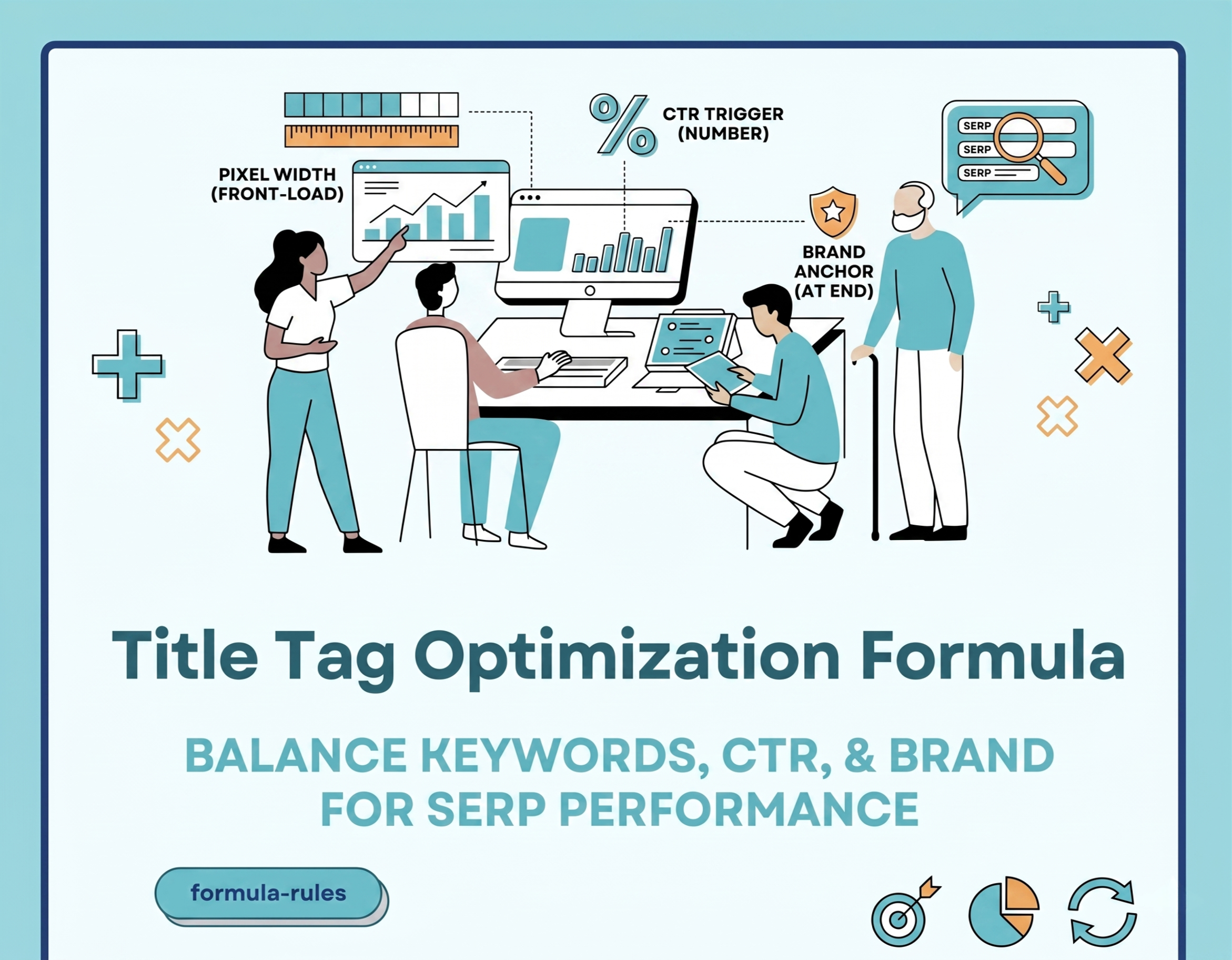
Treat every title tag as a sum: Primary Keyword + CTR Trigger + Brand Anchor, compressed into roughly 580 pixels. Each element competes for space, so weigh them by page intent.
For commercial pages, keywords carry the heaviest weight. Almost a third (31.91%) of original commercial titles include the target keyword, and Google mostly respects this, keeping keywords at nearly the same rate (31.31%) in displayed results. For informational pages, only 5.81% of original titles include the focus keyword. Knowing which intent your target keyword falls under – before writing the title – is the function of the systematic SERP-reading method documented in our SERP intent analysis guide.
A reliable structure:
[Primary Keyword] + [Specific Modifier or Number] + [Brand]
Example: Title Tag Optimization Formula: 7 Rules for 2026 | YourBrand
This places your keyword first, signals value with a number, and reserves the tail for brand recall – the order Google’s display algorithm tends to respect.
Pixel Width Has Replaced Character Count
The 60-character rule is outdated. Google now utilizes a pixel-width rendering system that displays approximately 600 pixels on desktop devices and 430 pixels on mobile. A “W” consumes more space than an “i,” so two 58-character titles can render very differently in the SERP.
Use a SERP simulator like SERPSim or Mangools before publishing. Aim for under 580 pixels and front-load critical terms within the first 350 pixels, the zone visible across every screen size.
Zyppy’s 2025 analysis found the sweet spot for title tags is exactly 51 to 60 characters, with the lowest rewrite rate. Titles shorter than 20 characters get rewritten over 50% of the time because Google reads them as uninformative. Anything over 70 risks mid-sentence truncation with an ellipsis.
What Makes a Title Survive Google’s Rewrite
Only 24% of title tags emerge from Google’s algorithm unchanged. The survivors share clear patterns documented in the 2025 McAlpin study:
- Unchanged titles averaged 44.47 characters and 7.39 words, versus 62.58 characters and 10.40 words for rewritten ones
- 84.87% fall within the 30–60 character range
- Intent-signalling openers: “how to choose,” “the 8 best,” “what is the”
- Current-year inclusion (Google favours freshness)
- List or question formats
What triggers a rewrite? Keyword stuffing affects 45% of penalized sites. Boilerplate phrasing like “Home” or “Welcome” gets replaced automatically. A more subtle rewrite trigger is intent mismatch – Google replaces titles when the page itself doesn’t match the SERP intent, regardless of how the title is written. The diagnostic for that is in our search intent mismatch guide. Heavy bracket use also flags titles – Zyppy’s 2025 report on 80,000 title tags found. Google is much less likely to remove parentheses than brackets, so swap [2026] for (2026) to protect your structure.
CTR Triggers That Actually Move Clicks
Specificity outperforms persuasion. Including precise numbers or specific counts in title tags can increase CTR by up to 27% – and unlike vague intensifiers, numbers survive Google’s rewrites because they signal credibility, not optimization.
Tactics that consistently lift CTR:
- Concrete numbers: “7 rules,” “12 metrics,” “$50K case study”
- Parenthetical clarifiers: “(2026 update),” “(case study),” “(with examples)”
- Outcome promises: “…without losing rankings,” “…in under 10 minutes”
- Comparison phrasing: “X vs Y,” “Why X beats Y”
Avoid generic modifiers like “ultimate,” “best ever,” or “complete guide” unless paired with specifics. A 2024 case study by SEO expert Tomislav Horvat saw CTR improvements ranging from 37% to a staggering 640% after cutting fluff and adding specific power words to old articles.
Brand Placement and the H1 Alignment Rule
Google removes brand names from modified title tags in 63% of cases. The reason: it now displays your Site Name separately above mobile results, making in-title branding redundant. Push your brand to the end with a pipe separator ( | YourBrand) rather than the front – and skip it entirely if your Site Name markup is already configured in schema.org.
A bigger 2026 shift: Google now runs a transparency check between your title tag and your H1. Title-and-H1 alignment is one of the 25 quality signals reviewed in our SEO content audit checklist, and one of the most commonly failed at scale. If your title tag differs significantly from your page’s H1 header, Google is now more likely to ignore your meta title and display your H1 instead. Misalignment also reduces your chances of being cited as a source in AI Overviews.
Keep title and H1 within roughly 80% lexical overlap. For brands sitting on a content portfolio with templated, under-optimised title tags, our SEO company in Kolkata re-engineers the full title-and-meta layer as a discrete deliverable inside the first 30 days of any retainer.
Testing in the AI Overview Era
The measurement game has shifted. AI Overviews now appear in 25.11% of Google searches, up from 13.14% in March 2025, and only 8% of users click links when AI summaries appear versus 15% without. Your title tag now functions as both a click target and a source-citation anchor for Gemini-generated answers.
Audit quarterly using Search Console’s CTR-versus-position data. Flag any page where displayed SERP titles diverge sharply from your written tags – that’s Google telling you your structure is off. Rewrite using the formula, ship, and recheck after 14 days.
Treat your title tag as a three-variable equation, not a keyword slot. Lead with the primary keyword, embed one specific number or modifier for CTR, anchor your brand at the tail, and audit against pixel width rather than character count. Align tightly with your H1 to clear Google’s transparency check and keep AI Overview citation odds intact. If Google is rewriting more than 70% of your titles, your structure – not your wording – is the problem. Start with your top 20 pages by impression count and rework them this week.