Most Google Business Profile audits are one-time events, run once at setup, referenced rarely afterward. That approach made sense in 2022. In 2026, the local ranking algorithm changes too quickly and responds too directly to competitor behaviour for an annual audit to be meaningful.
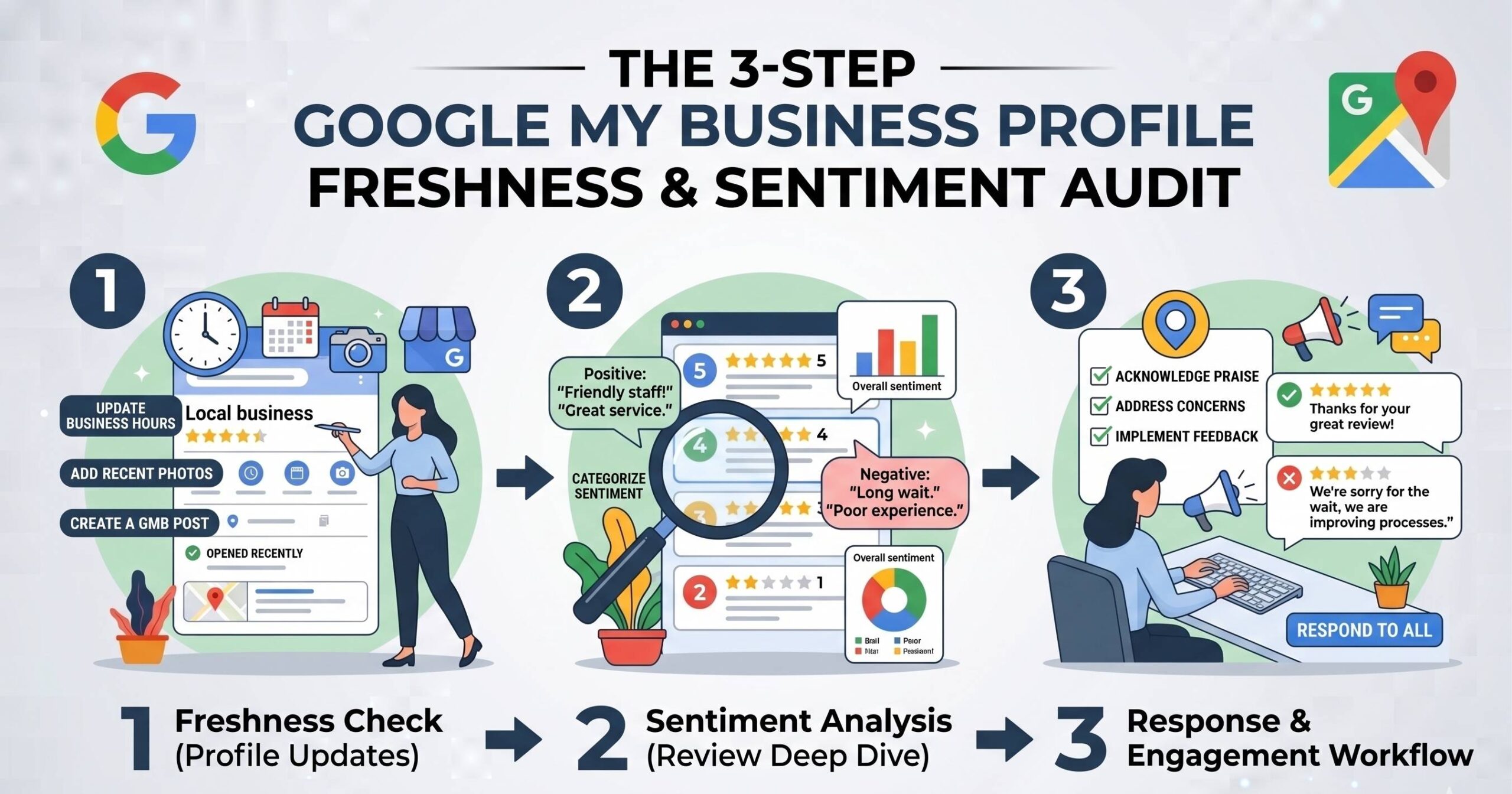
The 3-Step Google My Business Profile Freshness & Sentiment Audit is a monthly workflow designed to be completed in under 45 minutes. It measures the three dimensions of profile health that most directly determine 3-Pack position: freshness of activity, quality of review sentiment, and eligibility for AI-generated local summaries. Crucially, it measures these things relative to your actual competitors, not against an abstract standard. Competitor-relative measurement is also how our SEO services in Kolkata report local performance month-to-month.
Why Competitor-Relative Measurement Matters
Local search is inherently comparative. Google does not rank your profile against a perfect-score ideal, it ranks it against the other profiles competing for the same query in the same geography. A profile with moderate Activity Velocity can rank ahead of a more thoroughly optimised profile if all local competitors are equally inactive.
The audit below is designed to generate a score for your profile and your top two competitors simultaneously. The score gap between you and the leading competitor is more actionable than your absolute score.
Step 1 – The Freshness Audit
Check each of the following five content types on your profile and note the date of the most recent update. Score one point for each type updated within the last seven days. Maximum score: 5.
- Google Posts: When was the last Post published? What type was it (Offer, Update, Event)?
- Photos / Videos: When was the last image or video uploaded? Is the most recent video timestamped within the past 10 days?
- Reviews: Has a review been received and responded to within the past seven days?
- Q&A: Has a question been answered or a new Q&A pair added within the past 14 days?
- Attributes / Service Updates: Have any service listings, hours, or profile attributes been modified in the past 30 days?
Run the same check on your top two local competitors. Record all three scores side by side. Any content type where a competitor scores and you do not represent a direct freshness gap to close this week. For the underlying mechanic, see Activity Velocity: Why Monthly Posts Are Algorithmically Dead
Step 2 – The Sentiment Audit
Open your 20 most recent reviews and classify each one as either Specific or Generic. A Specific review mentions at least one of the following: a named service or product, a geographic reference (neighbourhood, city, or area), an outcome or result, or a team member by name. A Generic review contains only subjective praise, with no identifiable reference points. Score one point for each Specific review in your sample of 20. Maximum score: 5.
A score of 12 or higher (60%) indicates healthy sentiment signal density. Below 8 (40%) means your review content is not providing Google’s language model with the keyword and location associations needed for AI-generated local recommendation eligibility. The compliant playbook for closing that gap is in our [keyword-rich reviews guide]
Compare against your competitors using the same methodology. The competitor with the highest Sentiment Audit score has the strongest topical authority signal from their review corpus and is most likely appearing in AI-generated search summaries for your shared keywords.
Step 3 – The Visibility Audit
This step is binary and practical. Run the following checks from a mobile device using a personal Google account (not signed into your business account):
- Map pack check: Search your primary service keyword followed by your city. Does your profile appear in the top three results?
- Voice search check: Ask Google Assistant your primary service query with ‘near me’ appended. Is your business mentioned in the spoken response?
- AI Overview check: Search your primary service keyword on mobile. Does an AI-generated summary appear above the map pack? If so, is your business cited within it?
Score 1 if your profile appears in the map pack, 1 additional if it appears in voice results. The AI Overview question is diagnostic of businesses not cited in AI summaries, which lack sufficient entity completeness or semantic depth in their profile content. The fix is in our [voice search and AI summaries guide]
Reading and Acting on Your Total Score
Maximum total: 11 points (5 freshness + 5 sentiment + 1 map pack + 1 voice). Score interpretation:
- 9–11: Competitive. Maintain current cadence and monitor for competitor catch-up.
- 7–8: Functional but vulnerable. One competitor pulls ahead away from a 3-Pack exit. Address gaps immediately.
- Below 7: Actively losing ground. Prioritise the lowest-scoring step first and rebuild from there.
Run this audit on the same date every month. Track the score trend rather than fixating on individual monthly results. For brands managing multiple locations or who want the audit run as a service, our digital marketing team in Kolkata operates this on a recurring monthly cadence.
Conclusion
The 3-Step Google My Business Profile Freshness & Sentiment Audit turns a complex ranking system into a monthly 45-minute discipline. It does not require specialist tools, a mobile device, a competitor’s GBP, and a notepad are sufficient. What it requires is consistency: running the audit monthly, closing the identified gaps each week, and monitoring whether your score is pulling ahead of or falling behind the competitors you are directly competing with for local visibility.
FAQ
Q: How often should I run the GMB Profile Freshness & Sentiment Audit?
A: Monthly, on the same date each cycle. This gives you comparable trend data rather than point-in-time snapshots.
Q: Do I need paid tools to run this audit?
A: No. All three steps can be completed with a mobile device, Google Search, and direct access to competitor google my business profiles. Paid GeoGrid tools add precision to the map-pack check but are not required.
Q: What should I do if competitors consistently score higher than me?
A: Identify which of the three steps shows the largest gap and prioritise closing that specific dimension first. Freshness gaps are fastest to close; sentiment gaps take two to three months of consistent review collection.