Google reviews are not just a trust signal for prospective customers. In 2026, they are a source of structured language data that Google’s local ranking model uses to establish topical and geographic relevance for your business profile.
A business with 80 reviews averaging 4.8 stars, where each review says ‘great service, highly recommend,’ carries a fraction of the local authority of a business with 40 reviews, where each one mentions a specific service, a neighbourhood, and an outcome. The second business is providing Google’s language model with exactly the kind of entity-rich, intent-matched content it uses to surface profiles in AI-generated local summaries – covered in detail in our voice search and AI summaries guide – and voice search results.
The challenge is getting customers to write specific, detailed reviews, without crossing into the territory that Google’s 2026 spam detection penalises. This article covers the exact framework.
What Google’s 2026 Review Policy Prohibits
Google’s review spam policy prohibits the following:
- Incentivised reviews: offering discounts, gifts, or any benefit in exchange for a review, positive or otherwise.
- Scripted reviews: providing customers with written text and asking them to post it verbatim or with minor edits.
- Review gating: using software or processes that show a review prompt only to customers who indicate satisfaction, filtering unhappy customers before they reach the review form.
- AI-generated reviews: using any automated tool to generate or submit review content, including large language models.
- Bulk or templated patterns: reviews from different accounts that use identical or near-identical phrasing, even if each customer wrote their own.
oogle’s AI-assisted review authenticity scoring in 2026 is significantly more sensitive to templated language patterns than in previous years. Even well-intentioned guidance that leads multiple customers to phrase their reviews similarly can trigger a spam flag. Knowing exactly where the policy line sits is part of why our seo agency in kolkata runs review programmes in-house rather than outsourcing them to lead-gen tools that don’t read the policies.
What Google’s Policy Permits
Everything not on the list above is permissible. Specifically:
- Asking customers to leave a review: at any point in the customer journey, through any communication channel.
- Explaining what makes a helpful review: telling customers that specific details are useful to other buyers is not scripting a review, it is setting context.
- Making the review process easy: QR codes, direct review links, WhatsApp follow-ups, email sequences, and in-store prompts are all compliant.
- Responding to reviews: professionally and with natural keyword references.
The Specificity Conversation: How to Guide Without Scripting
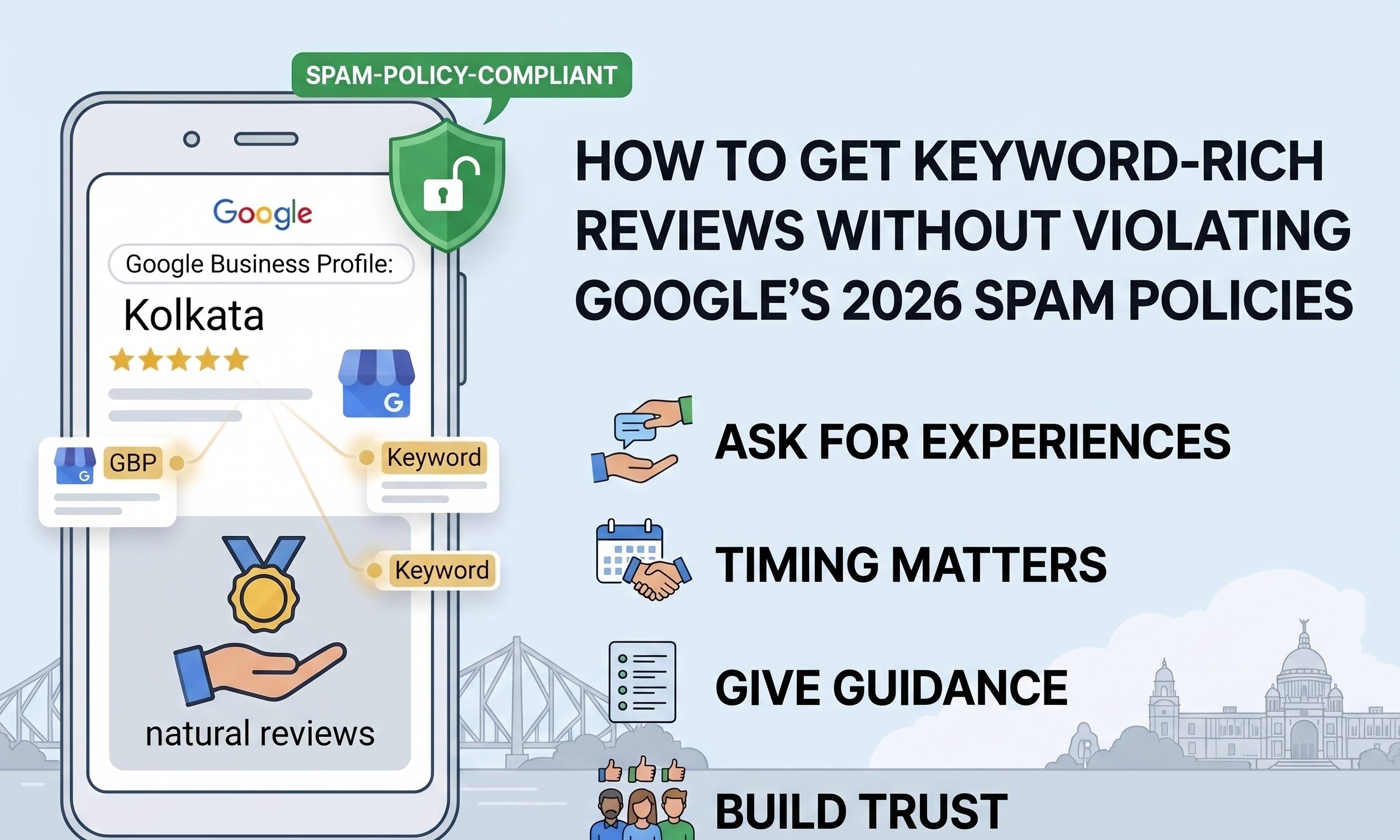
The most effective complaint method for generating keyword-rich reviews is what practitioners call the Specificity Conversation, a brief exchange at the natural end of a service interaction that primes the customer to write specifically without telling them what to write.
The framing is simple. When closing a service interaction, say, ‘If you do want to leave us a review, the most helpful thing for other customers is to mention what you came in for specifically and where you’re based, it helps people searching for the same service find us.’
That sentence does four things: it makes a review request that is not transactional, it explains the value of specificity to the customer rather than to you, it prompts location and service references without providing the words, and it gives the customer a reason to write more than ‘great service.’
The QR Card with a Context Prompt
A physical review card with a QR code linking directly to your Google review page is standard practice. What makes it effective for sentiment optimisation is the line below the QR code. Rather than ‘Please leave us a review,’ use: ‘Tell others what service you used and how it helped your details help customers in your respective city and find the right specialist.’
This prompt produces specific reviews without scripting them because it asks customers to reflect on their own experience rather than summarise it generically. The words ‘what service you used’ and ‘your details’ are invitations to specificity. The geographical reference of customers in their respective cities naturally surfaces in review text when customers follow the prompt.
Timing the Review Request for Maximum Detail
The timing of a review request directly affects the quality and specificity of the response. The worst time to ask is at checkout, the customer is distracted, in a transaction mindset, and unlikely to write more than a brief endorsement. The best time is 48 to 72 hours after a completed service, via WhatsApp or email, when the customer has had time to form and reflect on their experience.
A follow-up message structured as: ‘We hope [specific product or service] is working well for you — if you’re happy with the result, a Google review makes a real difference for other customers looking for the same thing’ produces measurably longer and more specific review content than a generic prompt.
Responding to Reviews: Indexed Content You Control
Every review response is indexed by Google – and contributes to one of the freshness signals tracked in the monthly 3-Step Freshness & Sentiment Audit. A response that says ‘Thank you for your kind words’ wastes the opportunity entirely. A response that naturally incorporates the service name, the outcome, and the location, ‘We’re glad the industrial leather welding gloves are performing well on your Kolkata site, our team takes particular care with safety specifications for industrial orders and adds keyword-relevant, location-associated content to your profile that compounds with each response.
Conclusion
Keyword-rich reviews are achievable without policy risk when the approach prioritises genuinely helpful communication over content manipulation. The Specificity Conversation, the context-prompted QR card, and the 48-hour follow-up sequence collectively shift the quality of review content without scripting it, producing the entity-rich language signals that local ranking models need, while remaining fully compliant with Google’s 2026 spam policies.
FAQ
Q: Can I ask customers to mention specific services in their reviews?
A: Not in specific scripted terms. You can explain that specific details make reviews more useful to other customers, which naturally leads them to mention services without being told what words to use.
Q: What happens if Google detects templated reviews?
A: Google’s spam detection can remove flagged reviews and, in repeated violation cases, suppress the entire review section of a profile. Reviews removed for spam violations cannot be restored.
Q: How many reviews per month is a good target?
A: In competitive Indian urban markets, a minimum of one new review every five days maintains review velocity above the threshold that influences local ranking. For healthcare and legal verticals, where reviews carry higher YMYL weighting, a higher velocity is advisable.
For brands that want their review-velocity programme built, scripted, and run on a compliant cadence, our digital marketing company in Kolkata deploys this as a structured ORM service line.