Google handles more than 8 billion searches daily, but since the 2013 Hummingbird update it stopped reading those queries as strings of words. It reads them as connections between entities distinct, identifiable concepts stored in its Knowledge Graph alongside hundreds of billions of facts. If your SEO strategy still revolves around keyword density and exact-match phrases, you’re optimizing for a search engine that hasn’t existed in over a decade. This article breaks down what entities actually are, how Google extracts and ranks them, and the specific technical and content moves that make your brand recognizable to its algorithms in 2025-2026.
What Google Actually Means by “Entity”
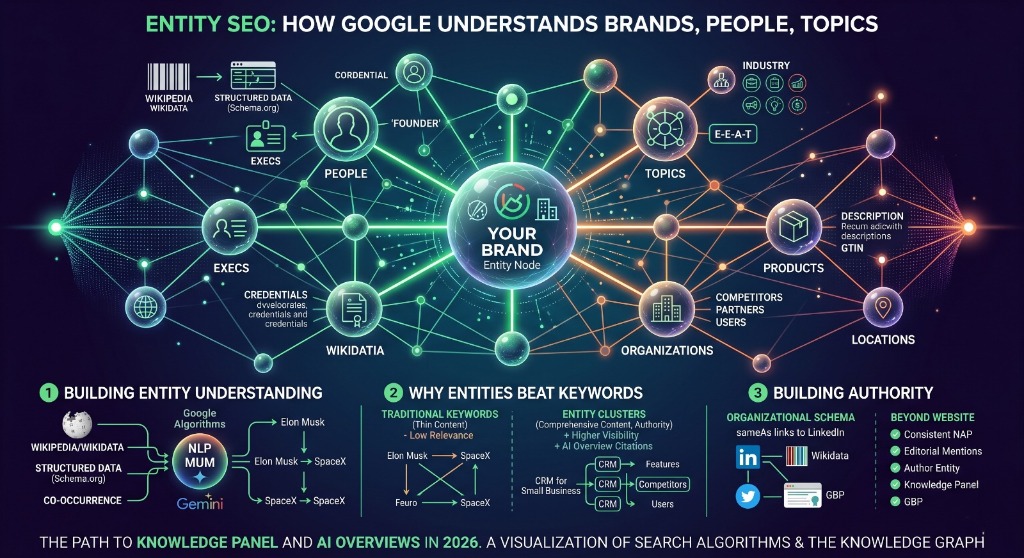
An entity is a singular, well-defined thing – a person, place, organization, product, event, or abstract concept with a unique identity. Google’s patents on entity-based search describe entities as nodes connected by edges representing relationships Elon Musk (entity) → founded (edge) → SpaceX (entity).
Entities carry attributes (Tesla → headquartered in → Austin), relationships (Tesla → competitor of → Rivian), and identifiers (Wikidata QIDs, legacy Freebase IDs). Unlike keywords, entities aren’t ambiguous. “Apple” the company and “apple” the fruit live as separate nodes with separate disambiguation signals and separate ranking ecosystems even though they share four letters on the page.
How Google Builds Its Entity Understanding
Google extracts entities through Natural Language Processing models currently MUM and Gemini-derived systems that parse content for named entities, classify them by type, then cross-reference each candidate against the Knowledge Graph for verification.
Three primary sources feed entity recognition:
- Wikipedia and Wikidata remain the highest-trust seed sources for entity creation and validation
- Structured data markup declares entities explicitly through Schema.org vocabulary
- Co-occurrence patterns across the open web confirm relationships and disambiguate context
Industry analyses consistently show the overwhelming majority of brands earning Knowledge Panels also have Wikidata entries. The pattern is unambiguous: Google verifies entities through multiple independent sources before granting them ranking prominence. A pattern we cover in detail in our breakdown of E-E-A-T signals Google actually measures.
Why Keywords Alone No Longer Win Rankings
Search operates on topical authority rather than keyword frequency. Query “best CRM for small businesses” and Google doesn’t scan for pages matching that string it identifies the entity (CRM software), the qualifying entity (small business segment), and the intent (comparison), then surfaces sources it associates with all three.
This is why thin pages targeting individual keywords lose to comprehensive resources covering the full entity cluster. For the budgeting logic that follows from this, see – the 4-quadrant intent framework. A page about email marketing automation needs to demonstrate understanding of related entities – Mailchimp, drip campaigns, list segmentation, CAN-SPAM compliance, deliverability metrics not simply repeat the focus phrase across H1 and meta tags. Competitive analysis of top-ranking pages now reveals breadth of entity coverage, not keyword stuffing patterns.
The Schema Markup That Actually Moves Rankings in 2026
Generic Schema.org markup is table stakes. The implementations driving entity recognition now include:
- Organization schema with sameAs properties linking your brand to Wikidata, Crunchbase, LinkedIn, and other authoritative profiles
- Person schema for founders and executives with verifiable credentials and external references
- Product schema with GTIN, MPN, and brand entity references for e-commerce nodes
- About and mentions properties declaring which entities a page covers as primary subjects versus references in passing
Google representatives have repeatedly confirmed that sameAs links function as entity reconciliation signals, This matters even more now that AI engines pull from these signals – see our AEO primer for the broader retrieval.
helping the algorithm disambiguate your brand from similarly named entities. If your business shares a name with a film, a band, or a public figure, this markup isn’t optional.
Building Entity Authority Beyond Your Website
Off-site signals matter as much as on-site declarations. Google triangulates entity trust from:
- Consistent NAP data (Name, Address, Phone) across business directories and citation sources
- Editorial mentions in publications Google already trusts, co-citation alongside authoritative entities raises your node’s prominence in the graph
- Author entities tied to bylined content, the connective tissue between E-E-A-T signals and entity authority
- Knowledge Panel completeness through Google Business Profile, verified social profiles, and Wikipedia inclusion where notability criteria are met
Recent core updates have visibly rewarded brands with strong off-site entity signals while demoting parasitic sites that are ranked primarily through keyword targeting on borrowed domain authority.
Measuring Entity Presence
You can’t manage what you don’t measure. Track these specific signals:
- Knowledge Panel triggers: does your brand surface a panel for branded queries?
- Entity-based visibility using tools like InLinks, WordLift, or Schema App
- AI Overview citations: Google’s generative results disproportionately cite recognized entities, making inclusion a primary KPI for 2026
- Wikidata QID assignment for your brand and key personnel
Run your homepage through Google’s Natural Language API demo to see which entities Google actually extracts. Mismatches between what you discuss and what Google identifies reveal optimization gaps you can close with targeted schema, content adjustments, and external citation building.
Conclusion
Entity SEO isn’t an alternative to keyword research, it’s the layer underneath it. Start by claiming and verifying your entity footprint: Google Business Profile, Wikidata entry where eligible, complete Organization schema with sameAs properties, and bylined content from verifiable authors. Audit your most important pages for entity coverage rather than keyword density. Then build co-citation through editorial placements and strategic partnerships. The brands winning AI Overview citations and Knowledge Panel real estate in 2026 are those treating their business as a node in Google’s graph, not a string in its index. That’s the work our AEO and entity SEO team in Kolkata does on every engagement.”*