Technical Structure and Internal Linking
Most pillar pages fail not because they lack content but because they lack architecture. A 5,000-word guide buried in a poorly linked URL structure with no schema markup and weak internal links to supporting cluster pages rarely outranks shorter, better-connected competitors. A true pillar page is not a long blog post, it’s the structural centre of a topic cluster, designed to consolidate topical authority, capture broad-intent queries, and feed ranking signals to dozens of related sub-topic pages. By the end of this article, you’ll understand exactly how to structure, link, and maintain a pillar page so it actually ranks and continues compounding authority over time. Before consolidating existing content into pillar architecture, run the diagnostic in our SEO content audit checklist.
What Separates a Pillar Page From a Long Blog Post
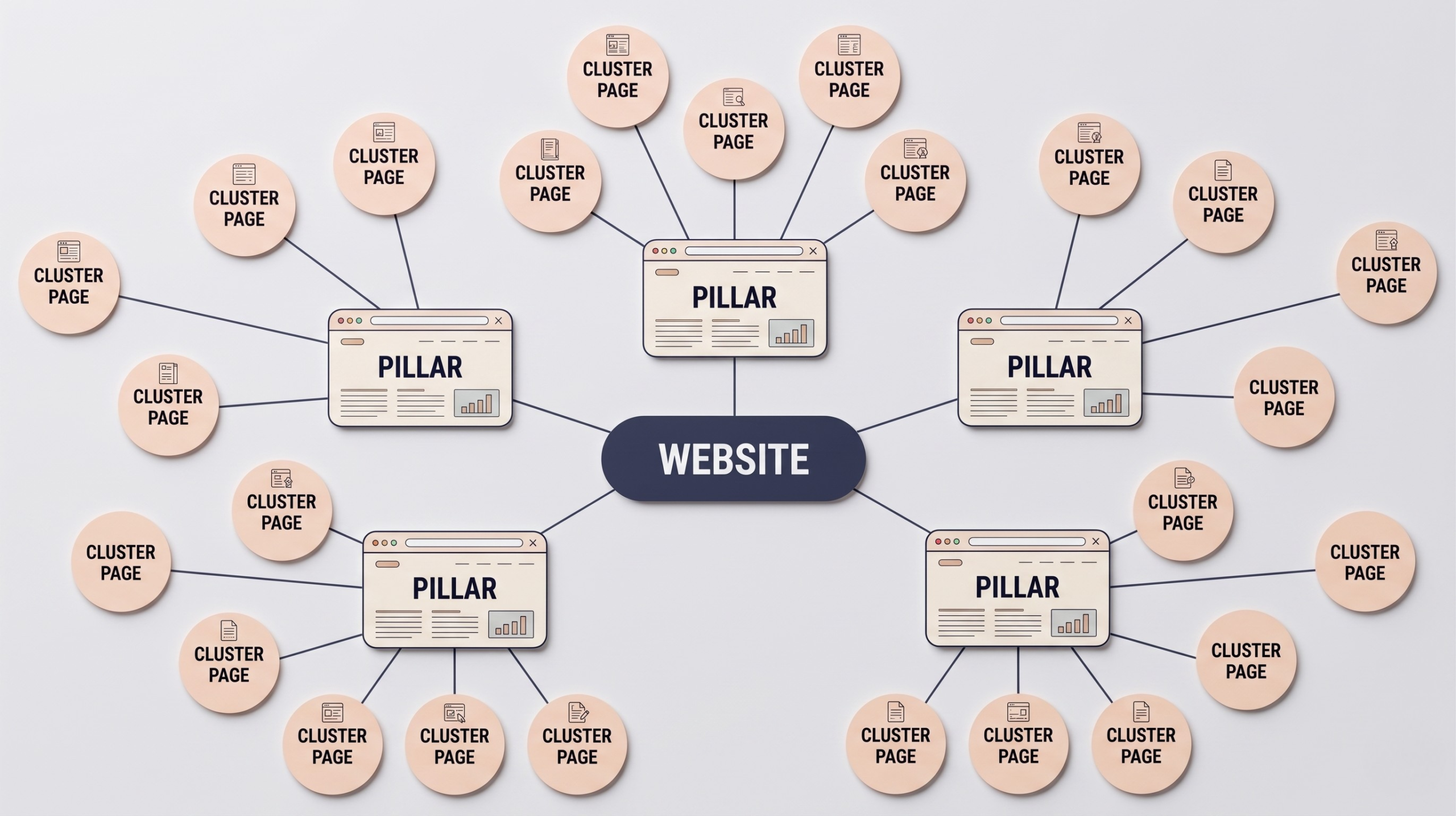
A pillar page covers a parent topic comprehensively enough that a reader needs no other source to understand the subject at a working level, while leaving room for deeper exploration through linked cluster pages. Length matters less than coverage breadth. A well-built pillar typically runs 2,500–4,500 words and addresses 8–15 sub-topics, each linking outward to a dedicated cluster page that handles that sub-topic in depth. The pillar answers the broad query; the clusters answer the long-tail variations. This structure tells Google that your domain has organised expertise around a subject rather than scattered articles. Engineering that organisation across a 50+ page content portfolio is part of how our SEO company in Kolkata builds topical authority for clients in competitive verticals
URL Structure and Information Architecture
Pillar pages should sit one level deep from the root: yourdomain.com/pillar-topic/ rather than buried under /blog/category/pillar-topic/. Cluster pages live one level beneath: yourdomain.com/pillar-topic/cluster-subtopic/. Avoid nesting beyond three levels because deep URLs dilute crawl priority and weaken the hierarchical signal. Add breadcrumb schema across the cluster so search engines understand the parent-child relationship explicitly. The deeper structured-data layer that makes pillar pages legible to AI engines and knowledge-graph systems is covered in our Entity SEO primer. Internal linking should reinforce this structure: every cluster page links back to its pillar with a consistent anchor variation, and the pillar links out to every cluster with descriptive contextual anchors embedded in relevant paragraphs. A clean URL and breadcrumb structure do more for pillar ranking than a thousand words of body content.
Internal Linking as the Real Ranking Mechanism
Internal linking is the engine that makes pillar pages rank. Every cluster page should contain at least one link to its parent pillar using either an exact-match or a close semantic-variation anchor. The pillar should link out to every cluster page using descriptive, intent-matching anchor text within natural paragraph flow – not jammed into a sidebar list. Beyond pillar-cluster relationships, cluster pages should also link laterally to 2–4 sibling clusters where topically relevant. This network creates a tight semantic web that signals topical authority to search engines. Sitewide footer links to pillars actually dilute the signal because they spread anchor equity across irrelevant pages. Keep pillar links contextual and intentional.
On-Page Structure for Featured Snippets and AI Citations
The internal heading structure determines whether your pillar gets cited in Google’s AI Overviews and pulled into featured snippets. Open each H2 section with a 40–60 word direct answer that defines the sub-topic in scannable prose — this is the answer block that AI extraction systems and snippet algorithms prefer. Follow with tables, numbered lists, and concise definitions where appropriate. Add FAQ schema at the bottom covering the 8–12 most common queries related to the pillar topic. Use the HowTo schema where the pillar involves process steps. Pages structured this way appear inside AI-generated answers far more frequently than walls of paragraph text, even when the underlying content is identical in substance. The full Answer Engine Optimisation playbook, including the schema patterns that earn AI Overview citations, is in our AEO breakdown.
Maintenance, Refresh Cycles, and Compounding Authority
A pillar page is not a one-time publish. Schedule quarterly content audits that update statistics, refresh examples, add new cluster page links as you publish them, and remove outdated references. Every new cluster page you publish strengthens the parent pillar, this is how topical authority compounds over time. Track pillar performance at the cluster level rather than by single keywords; the pillar’s value lies in the cumulative ranking improvement across 50–200 long-tail queries it supports through its cluster network. Pages neglected for more than nine months typically lose visibility regardless of how well they were originally built. Maintenance is the difference between a pillar page that ranks for three months and one that compounds for three years.
Ranking pillar pages succeeds because of structure, not length. Place them at shallow URLs, surround them with a hub-and-spoke cluster network, link them through descriptive contextual anchors, add schema that helps extraction systems understand their hierarchy, and refresh them on a fixed cadence.The pillar pages dominating competitive topics today are the ones treated as living architecture rather than static documents, designed to absorb authority from every cluster page that links back to them. For brands whose content already exists but is not organised into a pillar architecture, our engineering-led SEO services include a content-consolidation audit as a discrete deliverable.