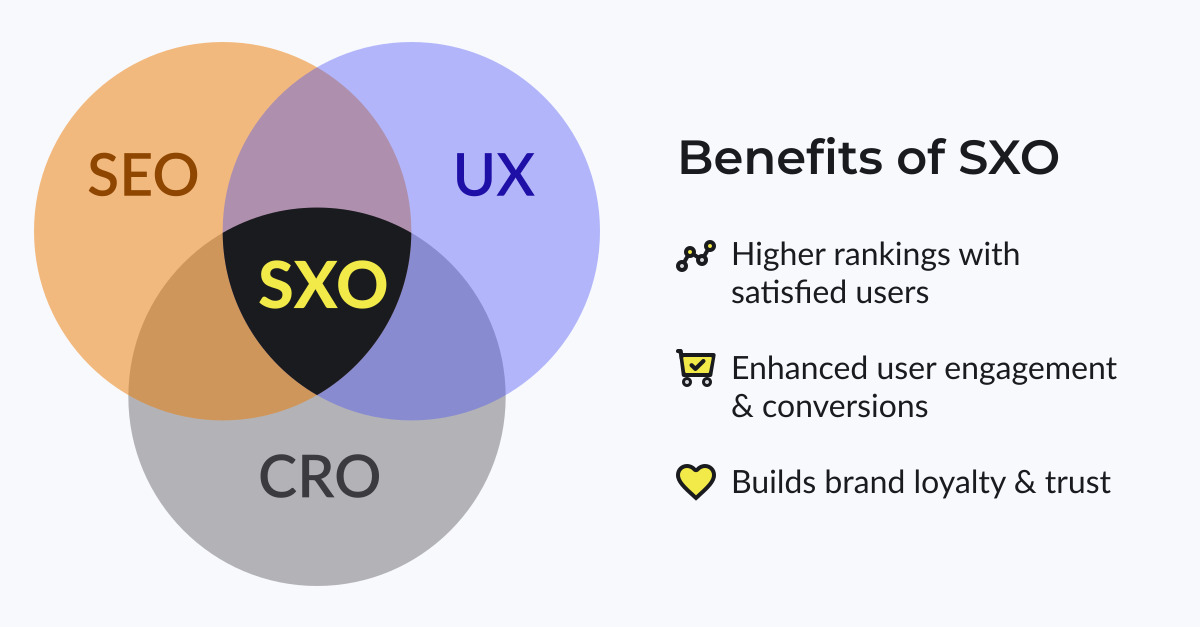
A page ranking first for a commercial query but converting at 0.4% is a marketing failure dressed as a success. SEO teams celebrate the ranking, CRO teams blame the traffic quality, and UX teams aren’t in the meeting. Meanwhile, Google’s Helpful Content System and Navboost ranking signals are quietly measuring whether users actually accomplish their goals on your page, and demoting you when they don’t. Search Experience Optimisation collapses these three disciplines into a single workflow that treats rankings, engagement, and conversion as one continuous funnel. This article maps the specific signals SXO targets, the tactical handoffs between disciplines, and the 2025-2026 framework that makes the integration measurable.
What SXO Actually Means in Practice
SXO is the discipline of optimizing the complete user journey from query intent to task completion, treating search visibility and on-site experience as a single integrated system rather than sequential handoffs between teams.
The premise comes from leaked Google ranking documentation and the Navboost system revealed in DOJ antitrust proceedings: Google measures user satisfaction through click patterns, dwell time, and return-to-SERP behavior, then uses that data to refine rankings. Pages that rank but fail users get downgraded. Pages that satisfy users get promoted regardless of traditional authority signals.
This makes the old separation between traffic acquisition and conversion obsolete. The same signals influencing whether you rank are the signals influencing whether users convert.
The Behavioural Signals Google Measures
Google has historically denied using engagement metrics as direct ranking factors. The 2024 Content Warehouse API leak contradicted that position, revealing systems like Navboost that explicitly track:
- Good clicks vs. bad clicks – long dwell sessions versus immediate returns to search results
- Last longest click – the final result a user makes before ending the search session
- Squashed clicks – patterns suggesting unsatisfying results that get algorithmically downweighted
- Site-level engagement aggregates that affect ranking across all pages on a domain
You no longer need to debate whether engagement matters. The leaked documentation confirmed what experienced practitioners suspected. Google has been measuring post-click satisfaction at the query level for years and folding it back into rankings.
Where CRO Slots Into the SEO Workflow
Traditional CRO operates after traffic arrives. SXO integration moves CRO upstream into the keyword research and content planning stages.
The practical implementation:
- Intent-conversion mapping – every target keyword gets paired with a specific conversion action appropriate to its funnel stage.
- Shared KPI dashboards between SEO and CRO teams, with engagement metrics like scroll depth and interaction rate visible alongside ranking and traffic data
- A/B testing with SEO guardrails – conversion experiments tested against crawlability and ranking impact, not just lift
- Heatmap analysis on ranking pages to identify friction between content discovery and conversion paths
A SaaS comparison page ranking for “best project management software” should not link to a generic homepage. The SXO version routes users directly to a comparison tool, a free trial flow, or a pricing calculator that matches the commercial intent of the query.
The Core Web Vitals Update Reshaping SXO in 2026
Google replaced First Input Delay with Interaction to Next Paint as a Core Web Vital in March 2024. INP measures responsiveness across every user interaction during a session, not just the first input. This single change has more practical impact on SXO than any algorithmic update in years.
INP rewards pages that stay responsive throughout the conversion flow. Forms that lag on the third field, dropdowns that freeze on selection, and modal windows that hesitate when opened, all now visible in field data and aggregated into your page experience signals.
The threshold to hit: INP under 200ms for 75% of page visits. Pages above 500ms are explicitly flagged as poor. You should pull Chrome User Experience Report data monthly and prioritize fixes on the highest-traffic pages with the worst INP scores.
Mapping User Intent to Page Experience
Different search intents demand different experience patterns, yet most sites apply a uniform template across page types.
Match the experience to the intent:
- Informational queries want fast answers, scannable structure, and minimal pre-content friction, no email gates, no autoplay video.
- Commercial investigation queries want comparison tables, specifications, and social proof above the fold.
- Transactional queries want streamlined paths to purchase with friction removed from checkout, not added through retargeting popups.
- Navigational queries want the specific entity or page the user typed, served without preamble.
A blog post ranking for “how to fix slow WordPress” with a newsletter pop-up interrupting after 15 seconds is sabotaging its own ranking. The pop-up generates a return-to-SERP signal that Navboost interprets as user dissatisfaction.
How to Audit and Measure SXO
The integrated metrics framework that connects all three disciplines:
- Engagement rate from GA4 as a baseline replacement for the deprecated bounce rate
- Scroll depth at 50% and 75% thresholds, tracked per landing page.
- Time to first conversion action – how quickly users hit the primary CTA after landing
- Search-to-conversion path length measured through assisted conversion reports
- Page experience signals from Search Console paired with conversion data per URL
Run a quarterly SXO audit on your top 20 traffic-driving pages. Cross-reference ranking position, INP score, engagement rate, and conversion rate in a single sheet. Pages ranking well with poor engagement are your priority fixes – they’re the ones Google will eventually demote.
Conclusion
Start by breaking down the wall between your SEO and CRO reporting. Build a shared dashboard covering ranking position, engagement rate, INP scores, and conversion rate per URL. Fix the pages where ranking is strong but experience signals are weak—they represent both the largest demotion risk and the largest revenue opportunity. SXO isn’t a new channel or tool; it’s the operating model that recognizes Google has been measuring the entire user journey for years, and your team should be optimizing for the same thing.