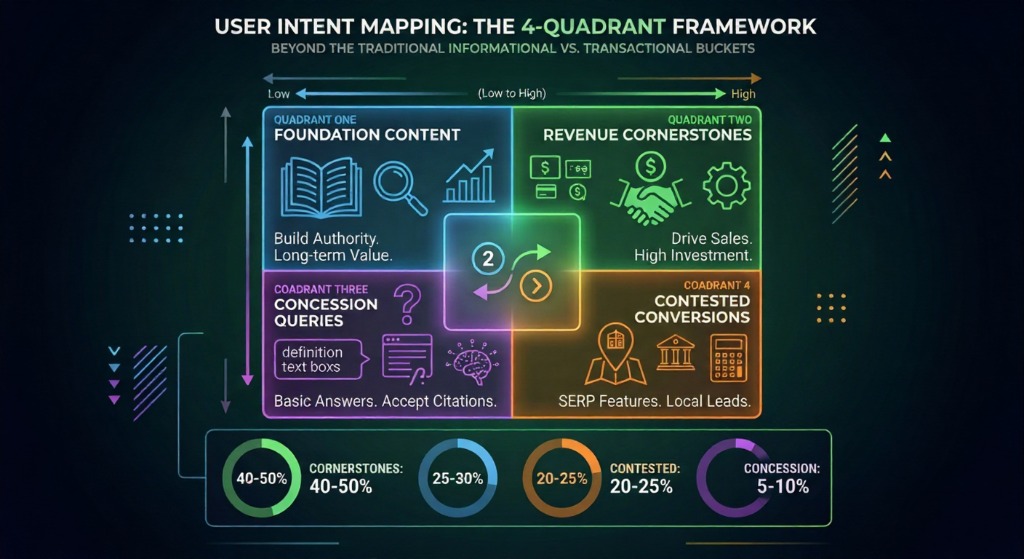
The four-bucket intent model, informational, navigational, commercial, transactional, was developed when search results were ten blue links, and AI Overviews didn’t exist. Today, it lumps together queries that demand completely different strategic treatment. A “best CRM software” search and a “what is a CRM” search both classify as “informational” or “commercial” under the old model, yet one drives demos, and the other gets fully answered by AI without a click. Classifying both the same way leads to identical content investments with wildly different returns. The seo agencies are scoped to this distinction from day one. This article introduces a two-axis framework that maps queries by AI vulnerability and conversion distance, then assigns resource allocation logic to each of the resulting four quadrants.
Why the Classic Four-Type Model Breaks Down
The Broder taxonomy from 2002, and its commercial-investigation extension, treats intent as a property of the query alone. It ignores two factors that now dominate ranking economics: whether an answer engine can fully resolve the query without sending a click, and whether the query is connected to revenue.
A high-volume “informational” keyword that gets absorbed entirely by an AI Overview generates impressions but no traffic. Pursuing it with a 2,500-word guide is a waste of production capacity. Meanwhile, a low-volume “transactional” query with strong commercial intent and AI resistance may justify ten times the investment per search. The classic model can’t see this distinction.
The Two Axes That Define Modern Intent
The framework uses two independent variables:
- AI Answer Vulnerability (low to high) – how completely can a generative answer engine resolve the query without a click? Definitions, basic facts, and simple how-to queries are highly vulnerable. Comparison, evaluation, and locally specific queries are less vulnerable.
- Conversion Distance (far to near) – how directly does ranking for this query produce revenue? Top-of-funnel awareness queries are far, bottom-of-funnel “pricing” and “near me” queries are near.
Plotting any keyword on these two axes lands it in one of four quadrants, each with a distinct strategic playbook. This is where Answer Engine Optimisation (AEO) starts to replace traditional ranking strategy for the high-vulnerability quadrants.
Mapping the Four Quadrants
Quadrant One: Foundation Content (Low AI Vulnerability + Far Conversion)
Queries like “how marketing attribution actually works” or “differences between EBITDA and operating cash flow.” These reward depth, original frameworks, charts, and expert perspective, content AI engines summarize poorly because the value lies in nuance and example.
Strategic role: brand authority, link acquisition, internal linking equity, and topical depth that support rankings on more commercial pages. Production cost is high; direct conversion is low; long-term compounding value is significant.
Quadrant Two: Revenue Cornerstones (Low AI Vulnerability + Near Conversion)
Comparison pages (“Salesforce vs HubSpot”), pricing pages, demo request pages, and bottom-funnel commercial queries. These resist AI summarisation because users want to evaluate, configure, or transact actions that an AI Overview cannot complete.
Strategic role: direct revenue. These pages justify the highest production investment, the most rigorous CRO testing, and the deepest structured data implementation. AA 5% conversion improvement on a revenue cornerstone outweighs a 50% traffic increase on a Quadrant Three page. The discipline that makes that 5% achievable is covered in our SXO breakdown
Quadrant Three: Concession Queries (High AI Vulnerability + Far Conversion)
Definition queries, simple how-tos, basic facts. “What is project management?” gets fully answered in an AI Overview snippet. The click-through rate continues to decline as answer engine adoption grows.
Strategic role: minimal investment. Maintain coverage through lightweight FAQ sections within larger content hubs rather than dedicated pages. Accept that you may earn citations without earning traffic. Do not fund full content production for queries you’ve conceded.
Quadrant Four: Contested Conversions (High AI Vulnerability + Near Conversion)
Mortgage rate calculators, “lawyer near me,” product price queries, and shipping cost questions. These have commercial intent but are increasingly answered by AI features, Maps, or shopping carousels before users see organic results.
Strategic role: defensive optimization. Win the SERP feature rather than the blue link. Implement aggressive structured data, target Local Pack inclusion, and build tools or calculators that the AI surfaces would rather link to than reproduce.
Resource Allocation Logic Across Quadrants
The framework’s practical output is a budgeting model. A reasonable starting allocation:
- Revenue Cornerstones: 40-50% of content and optimization budget
- Foundation Content: 25-30% for long-term authority compounding
- Contested Conversions: 20-25% with emphasis on SERP feature optimization
- Concession Queries: 5-10%, treated as coverage rather than investment
Most teams have these proportions inverted. Audit any agency’s content calendar, and you’ll typically find heavy investment in Concession-tier queries chosen for search volume rather than strategic value. The framework reveals why those pages produce traffic that doesn’t convert and rankings that don’t matter. Our seo expert team in kolkata audits exactly this gap before any content production starts.
Auditing Your Existing Keyword Portfolio
Plot your current ranking keywords against the two axes using three data points: AI Overview presence (visible in Search Console and SERP scrapers), commercial value per click, and current organic conversion rate.
The audit reveals four common patterns:
- Misallocated investment: heavy production sitting in Quadrant Three
- Underinvested cornerstones: thin pages in Quadrant Two with strong commercial signals
- Missing foundation depth: no authority-building content in Quadrant One feeding cornerstone rankings
- Undefended contested queries: Quadrant Four searches lost to SERP features
Rebalance by reallocating production hours from Concession Queries into Cornerstones and Foundations over the next two quarters. Track engagement rate and assisted conversions per quadrant, not just rankings.
Conclusion
Replace your existing keyword sheet’s “intent type” column with two new columns: AI vulnerability and conversion distance. Plot the resulting matrix and identify your real Revenue Cornerstones, the queries that are AI-resistant and conversion-near. Concentrate production capacity there, build Foundation Content that feeds them with authority signals, defend Contested Conversions with SERP feature optimization, and stop overproducing for Concession Queries that no longer earn clicks. The teams winning organic revenue aren’t ranking for more keywords. They’re ranking for the right ones. For the entity-level work that supports cornerstone authority, see our Entity SEO primer