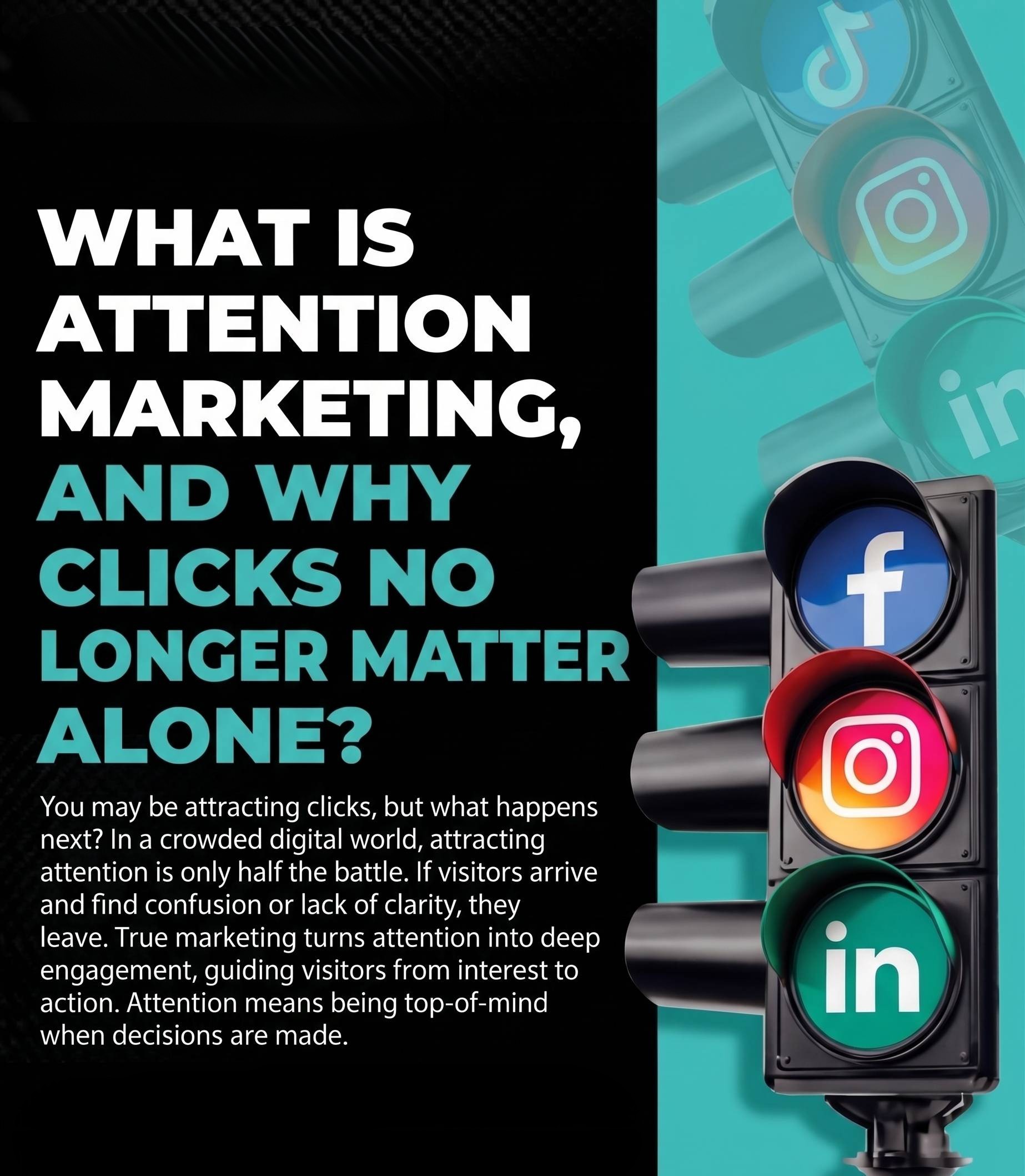
The average banner ad CTR sits near 0.05%, and even paid social click-through has eroded year after year while ad spend continues to climb. The math no longer adds up, and marketers who still optimise primarily for clicks are funding a metric that has quietly stopped reflecting actual influence. Attention marketing is the response to this collapse, a discipline that treats human focus, not interaction, as the real currency of growth. It prioritises how long, how often, and how meaningfully a person engages with your brand over whether they tap a link. By the end of this article, you’ll understand what attention is, in operational terms, and how to build a marketing system around it.
The reframing below – from click-based to attention-based campaign design – is why our digital marketing agency in Kolkata measures every paid programme against engagement-quality KPIs alongside conversion volume.
Why the Click Stopped Being a Reliable Currency
Clicks once worked as a proxy for interest because the open web was small and intent was scarce. The macro context – why attention itself has become the scarcest resource – is in our analysis of how consumer attention became the most valuable currency in digital marketing.
Today, a click can be an accident, a bot, a curiosity tap that closes in two seconds, or a deliberate misread of a thumbnail. Performance dashboards reward this noise because volume is easy to report. Meanwhile, the buyer who watched your founder’s 90-second video three times last month, then searched your brand directly, never registers in any click-based attribution model. The result is a measurement layer that overstates cheap interactions and undercounts the engagements that actually move purchase decisions. Marketers who treat clicks as the headline KPI end up scaling waste with surgical precision.
Today, a click can be an accident, a bot, a curiosity tap that closes in two seconds, or a deliberate misread of a thumbnail. Performance dashboards reward this noise because volume is easy to report. Meanwhile, the buyer who watched your founder’s 90-second video three times last month, then searched your brand directly, never registers in any click-based attribution model. The result is a measurement layer that overstates cheap interactions and undercounts the engagements that actually move purchase decisions. Marketers who treat clicks as the headline KPI end up scaling waste with surgical precision.
The Metrics That Actually Signal Attention
Modern platforms already rank content by attention, not clicks, you simply need to align your reporting with how their algorithms think. The behavioural-analytics layer that makes attention quantifiable is documented in our analytics guide for digital marketing. YouTube weighs average view duration and retention curves. Reels measure completion rate and rewatches. LinkedIn factors dwell time on posts. Newsletters track open-to-read time and forwards. Pull these into a single dashboard alongside scroll depth on landing pages, video completion percentage, save and share rates on social, and time-on-page for cornerstone articles. These signals tell you whether your content earned a moment of focus or simply flashed by. A post with 200 saves and 30 shares is operationally more valuable than one with 5,000 link clicks and zero downstream behaviour.
Where Sustained Attention Now Lives
Paid media buys you rented attention. The psychological mechanics behind content that earns sustained attention organically are in our viral marketing psychology breakdown. The moment your budget pauses, the audience disappears. Sustained attention lives inside owned and earned ecosystems, newsletters, podcast hosts, YouTube channels, niche Discord and WhatsApp communities, and creators who have built habitual viewership in your category. A skincare brand collaborating with three dermatology creators on long-form explainer content earns durable mindshare that outlasts any single ad burst. Media plans now routinely allocate a meaningful share to creator partnerships and content sponsorships rather than spending the entire budget on auction-based impressions. Owned channels compound. Rented channels reset to zero the moment you stop paying. Your attention strategy needs both, with the long-term weight tilted toward what you can actually keep.
Designing for Saturation Instead of Single Visits
The mere-exposure effect, well documented in consumer psychology, shows that repeated familiar contact builds trust and recall faster than a single high-effort impression. Attention marketing applies this principle through deliberate creative repetition: a recognisable colour system, a recurring tagline structure, a consistent founder face, a signature sonic logo. Brands like Liquid Death, Zudio, and Cred have engineered visual codes that work across thirty platforms because the design language is unmistakable in under two seconds. Your creative system should let any single asset reinforce the whole. That requires fewer one-off campaigns and more modular templates that flex across formats. Saturation works when every piece feels related but never identical, which keeps the brand familiar without making the audience fatigued.
Brand Recall as the Real Conversion Layer
Performance marketing closes the demand that brand marketing creates. When attention compounds correctly, branded search volume rises, direct traffic strengthens, and your paid campaigns get cheaper because click-through and conversion rates lift on the back of recognition. This is measurable. Track branded query growth in Search Console, monitor direct traffic against content publication dates, run quarterly brand lift surveys, and watch share-of-search against your closest competitors. A category leader typically holds 30–40% share-of-search inside its niche. If yours sits below 10%, your attention investment is underweight regardless of what your click reports look like. The conversion you see at the bottom of the funnel is the residue of attention earned weeks or months earlier.
Measuring Without Worshipping the Click
Drop the obsession with isolating last-click ROI on every line item. Build a measurement model that combines platform-native attention metrics, branded search lift, post-view conversion windows from Meta and YouTube, qualitative signals like inbound DMs and word-of-mouth mentions, and periodic survey-based brand tracking. Treat short-window performance metrics as tactical feedback and long-window attention metrics as strategic feedback. They answer different questions: one tells you whether a creative is working this week, the other tells you whether your brand is becoming more valuable this quarter. Marketers who run both lenses together make sharper budget decisions than those who pick one.
Attention marketing isn’t a rejection of performance, it’s an honest acknowledgement that human focus, not interaction count, is what builds enduring brands. Reorient your reporting around dwell, completion, recall, and share-of-search. Invest in owned channels and creator partnerships that compound. Design creative systems that earn familiarity through deliberate repetition. The marketers who win the next decade will be the ones who stop renting clicks and start owning attention, because every other metric in your funnel ultimately follows from it.