Meta has spent the last few years pushing advertisers toward automation, and Advantage+ Shopping Campaigns (ASC) sit at the centre of that strategy. The pitch is simple: hand over audience selection, placement decisions, and creative testing to Meta’s machine learning, and the system finds buyers more efficiently than manual setups. The reality is more nuanced. ASC outperforms manual campaigns in specific scenarios, underperforms in others, and is rarely the right answer as a standalone strategy. By the end of this article, you’ll know exactly when to deploy ASC, when to stay manual, and how to build a hybrid structure that uses both for what each does best.
The decision framework below mirrors the rollout playbook our social media marketing agency in Kolkata uses when migrating D2C accounts from manual ASC.
What Advantage+ Shopping Actually Automates
ASC bundles several automation layers into a single campaign type. The same automation-vs-control question shapes Google strategy too, and the playbook for the Google side is in our Performance Max campaigns guide.
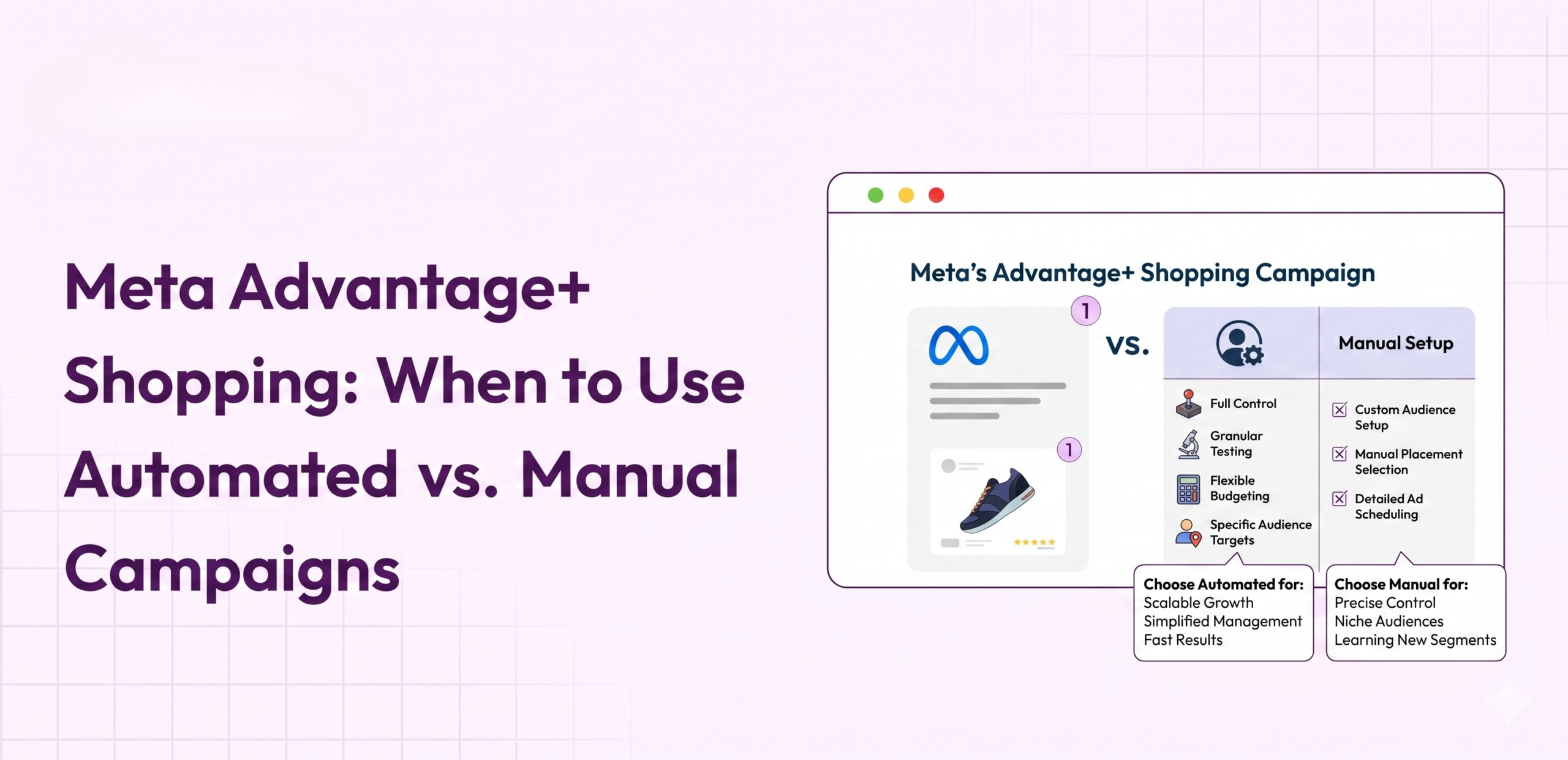
ASC auto-selects audiences from your pixel data and Meta’s broader behavioral graph, dynamically tests up to 150 creative combinations, optimises placements across Facebook, Instagram, Messenger, and Audience Network, and allocates budget toward the highest-converting variants. A built-in existing-customer cap, which you set anywhere between 0% and 100%, controls the proportion of budget spent on retargeting versus prospecting. What ASC doesn’t automate is your catalogue quality, your creative bench depth, or your conversion event hierarchy, all of which materially affect performance. The behavioural-analytics setup that lets you trust the algorithm’s optimisation is documented in our analytics guide for digital marketing.
What ASC doesn’t automate is your catalogue quality, your creative bench depth, or your conversion event hierarchy, all of which materially affect performance.When ASC Outperforms Manual Campaigns
ASC consistently wins in three scenarios. First, established e-commerce brands with deep pixel history (at least 50 conversions per week) feed the algorithm enough signal to find buyers efficiently. Second, brands with large product catalogues benefit because ASC can dynamically test product combinations across audience segments faster than any manual structure. Third, brands with strong creative benches, ten or more performing assets, give ASC enough variety to run meaningful dynamic creative tests. If you’re spending more than ₹4 lakh per week on Meta with a tight ROAS target and your audiences have started overlapping across manual campaigns, ASC almost always recovers wasted reach.Indian D2C brands in skincare, apparel, and home furnishings have reported 18–30% lower CPA after consolidating fragmented manual structures into ASC. The macro reason machine-learning bidding wins on attention metrics is covered in our attention marketing primer.
When Manual Campaigns Still Win
ASC underperforms in equally specific scenarios. New brands without sufficient pixel data starve the algorithm and end up paying inflated CPMs while the system explores. Niche products with narrow buyer personas, premium B2B SaaS, professional services, and hyper-local offerings need the precision targeting that manual interest, lookalike, and custom audience layers still provide. Lead generation campaigns optimising for form submissions or demo requests almost always do better on manual structures because ASC is purchase-optimised by design. If you’re testing a new creative angle that needs isolated reading, the manual gives you cleaner data than ASC’s blended attribution. Geographic launches, demographic-specific products, and seasonal pushes with sharp targeting requirements all benefit from manual control.
Catalogue and Creative Prerequisites for ASC Success
ASC is only as strong as the inputs you give it. Your product catalogue needs accurate titles, current pricing, high-quality images, and availability status updated daily. Meta’s algorithm penalises stale feeds by deprioritising those products in dynamic ads. Your creative bench needs depth and variation: at least 6–10 unique assets per ASC campaign, mixing static images, single-product carousels, lifestyle videos, and user-generated content. Define your existing customer audience precisely (past 180 days of purchasers from your CRM, not just pixel data) so the customer cap actually means something. Without these prerequisites, ASC underdelivers regardless of budget size, and most claims that “ASC doesn’t work” trace back to weak catalogue or creative inputs rather than the campaign type itself.
The Hybrid Structure Most Brands Should Run
Running ASC in isolation leaves performance on the table. The structure working best for mid-to-large D2C brands allocates roughly 60–70% of the budget to ASC for scaled prospecting, 15–25% to manual campaigns for testing new creative angles, audience segments, and geographic expansions, and 10–15% to dedicated retargeting for cart abandoners and high-intent site visitors. The manual layer becomes your laboratory, new ad concepts get validated there before being graduated into the ASC creative pool. Retargeting stays separate because ASC’s blended audience approach dilutes warm-audience conversion rates. This structure gives you both the scale of automation and the control of manual testing without sacrificing either.
Advantage+ Shopping is a powerful execution layer, not a complete strategy. Use it when your pixel is rich, your catalogue is clean, and your creative bench is deep. Stay manual for early-stage brands, niche audiences, lead generation, and isolated testing. The brands extracting the strongest Meta performance are running both in deliberate proportions, treating ASC as the scaling engine and manual as the testing ground that feeds it.