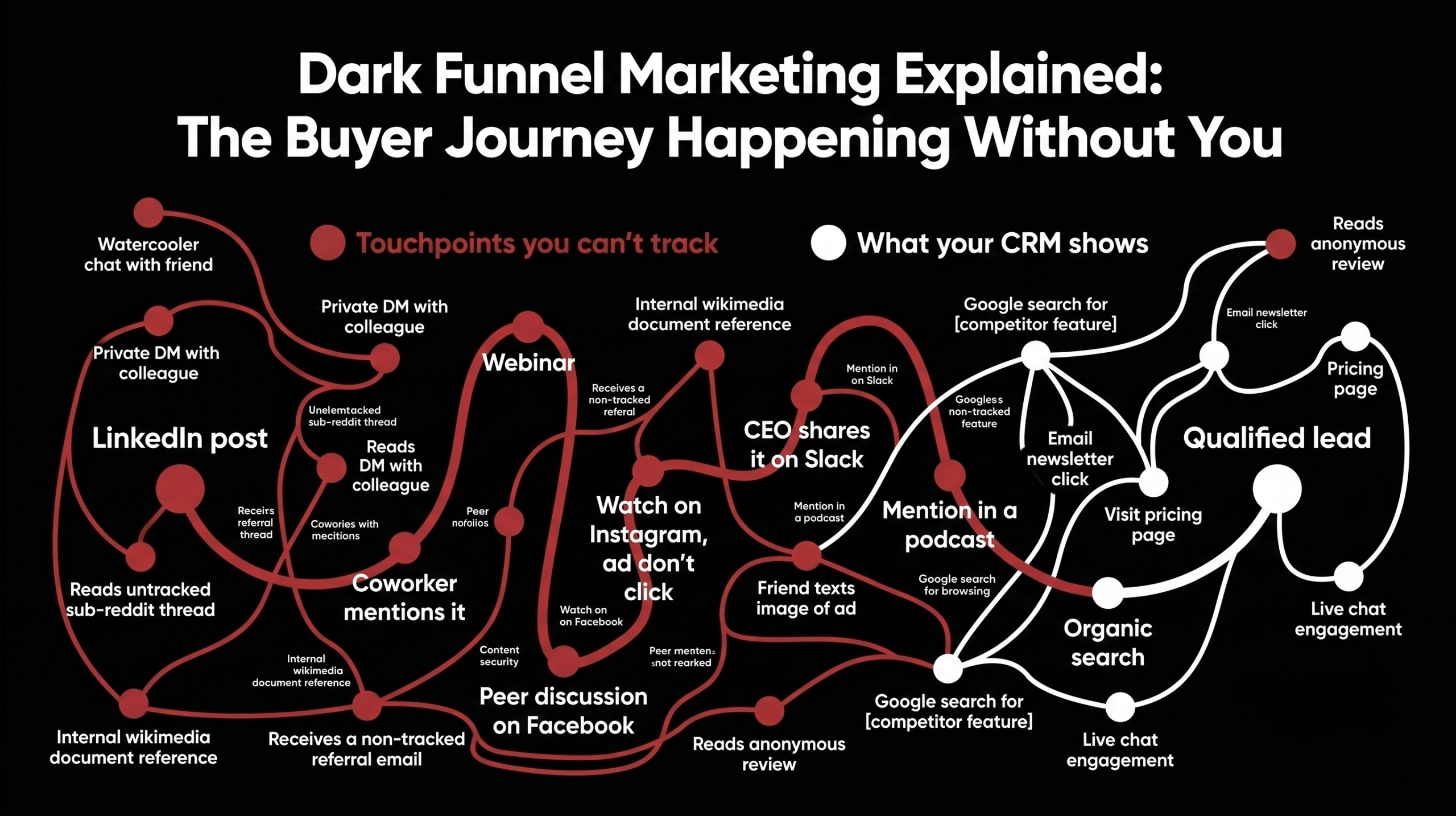
By the time a prospect fills out your demo request form, they’ve already decided. Not tentatively decided. They’ve read the Reddit threads, watched the YouTube teardowns, compared you in a LinkedIn DM with a peer, and maybe even asked ChatGPT which platform is better for their use case. None of that showed up in your GA4 dashboard. None of it touched your UTM parameters. And yet, it drove the conversion.
This is the dark funnel, the invisible layer of B2B buying behavior that attribution tools were never built to capture. For marketers who’ve staked their credibility on last-click reporting and MQL counts, it’s an uncomfortable reality. But for those willing to operate beyond what’s measurable, it’s a significant competitive edge.
By the time a prospect fills out your demo request form, they’ve already decided. Building a buyer journey that does not depend on last-click attribution is why our digital marketing services in Kolkata instrument every account with server-side tracking and modelled-conversion attribution from day one.
What the Dark Funnel Actually Is
The dark funnel isn’t a marketing channel. It’s the aggregate of all the untracked, unattributed touchpoints where buyers form opinions, build trust, and make decisions, before they ever signal intent to a sales team.
It includes: private Slack communities and Discord servers where peers swap vendor recommendations, podcast episodes consumed during commutes, newsletter content forwarded between colleagues, social media scrolling that never results in a click, and AI-powered search responses that surface your brand (or your competitor’s) without a single traceable visit to your website.
In B2B specifically, Forrester data has consistently shown that buyers complete 60–70% of their decision-making process before engaging with a vendor. Dark funnel and demand generation are two halves of the same playbook – the strategic frame is in our demand generation breakdown.
Why Traditional Attribution Breaks Here
Your CRM records the meeting booked from the paid search ad. It doesn’t record the three Slack conversations that preceded it, the G2 reviews that were cross-referenced, or the founder’s Twitter thread that initially triggered consideration.
Last-touch and even multi-touch attribution models were designed for a traceable web. The attribution toolkit for tracking the trackable share of the dark funnel is in our behavioural analytics guide. Cookies, UTMs, and pixel-based tracking assume buyers follow a visible path. They don’t, especially in 2026, where consent-based browsing, ad blockers, and cross-device journeys have made digital breadcrumbs increasingly unreliable.
The result is a systematic undervaluing of brand, community, and content investments, precisely because these channels operate most effectively in the darkhe result is a systematic undervaluing of brand, community, and content investments, precisely because these channels operate most effectively in the dark. The shift covered here is one face of the broader attention economy – fully mapped in our analysis of consumer attention as the most valuable currency in digital marketing.
How to Influence What You Can’t Measure
Acknowledging the dark funnel doesn’t mean accepting helplessness. It means shifting from attribution-first thinking to influence-first strategy.
Start with the share of voice in the places where your buyers actually congregate. Identify the subreddits, LinkedIn groups, Slack communities, and industry forums where your ICP discusses problems your product solves. The goal isn’t to advertise there, it’s to be genuinely present, helpful, and recognizable.
Invest in executive and founder visibility. When a CEO or head of product consistently publishes insightful content on LinkedIn or appears on industry podcasts, they become a reference point in conversations you’ll never see. That name recognition travels through dark channels far more effectively than a retargeting banner.
Third-party validation, G2, Capterra, Trustpilot, and independent reviews function as dark funnel infrastructure. Buyers check these sources autonomously, often without your brand’s involvement. Maintaining strong review profiles and seeding authentic testimonials isn’t just reputation management; it’s an active dark funnel strategy.
Finally, use first-party signals as a proxy. Spikes in branded search volume, direct traffic growth, and increases in inbound demo requests that can’t be attributed to a specific campaign are all indicators that dark funnel activity is working. They’re lagging indicators, but they’re real.
Self-Reported Attribution: The Practical Bridge
One of the most underused tactics in B2B marketing is simply asking. Adding a single open-text field to your demo form “How did you first hear about us?” returns data that no tracking pixel can capture.
Analyze these responses at scale. You’ll start seeing patterns: “a colleague recommended you,” “I saw your founder on a podcast”,” someone posted about you in a Slack group.” These aren’t edge cases, they’re often the plurality of responses, and they reveal exactly where your dark funnel is generating influence.
This qualitative layer, combined with your quantitative funnel data, gives a far more accurate picture of how buyers actually find and choose you.
Building a Dark Funnel Strategy in Practice
A practical dark funnel playbook looks something like this:
Map your ICP’s information ecosystem, where do they consume content, have conversations, and seek peer validation? These are your dark funnel channels.
Create content designed to travel, frameworks, strong opinions, original data, and proprietary research get shared in conversations where you have no presence. A well-crafted LinkedIn post gets copy-pasted into a Slack DM. A benchmark report gets referenced in a board meeting.
Partner with trusted voices in your space. When an analyst, respected practitioner, or community moderator mentions your brand authentically, it carries weight that no paid placement can replicate.
Build community ownership. The brand that runs or sponsors the community where buyers congregate has structural dark funnel advantage. Even a low-volume Slack community of 300 qualified buyers generates more influence per member than a 10,000-person email list of cold contacts.
The dark funnel won’t get easier to measure, if anything, privacy regulations, AI-generated summaries, and platform fragmentation will make it harder. The marketers who win in this environment won’t be those who figure out how to track it. They’ll be the ones who build brands compelling enough that buyers find them through channels that were never meant to be tracked in the first place.
Frequently Asked Questions
Can dark funnel activity ever be tracked?
Partially. Self-reported attribution, branded search trends, and dark social tools like Orbit or Common Room can surface some signals, but full attribution isn’t possible by definition.
Is the dark funnel more relevant for B2B or B2C?
Both, but the impact is more pronounced in B2B, where buying decisions involve multiple stakeholders, longer cycles, and significant peer consultation.
How do I justify dark funnel investment to leadership?
Use pipeline velocity and win-rate data alongside branded search growth and self-reported attribution to build a qualitative case. Revenue correlation over time is your strongest argument.
Does SEO play a role in the dark funnel?
Indirectly. Strong organic visibility builds brand familiarity that primes buyers for dark funnel influence, they’re more receptive to a brand they’ve encountered in search before peers mention it.