
Content marketing budgets in Asia-Pacific are projected to grow 14% year-on-year through 2026, yet research from the Content Marketing Institute consistently finds that fewer than 30% of B2B marketers rate their content programs as effective. The investment is increasing, while confidence in the outcomes is not. That gap does not exist because content marketing does not work, it exists because most businesses are making the same structural errors that prevent otherwise reasonable content programs from producing measurable returns.
The most damaging content marketing mistakes are not typos, inconsistent posting schedules, or suboptimal headline formulas. They are architectural: strategic misalignment between content topics and buyer intent; measurement frameworks that track activity rather than outcomes; distribution systems that publish without reaching the intended audience; and content programs that generate traffic without building trust. These errors are harder to spot than execution-level problems, which is why they persist across industries and business sizes.
This article identifies the highest-impact content marketing mistakes, explains the specific mechanism by which each one undermines business outcomes, and provides the diagnostic questions and corrective frameworks that allow marketers to address them without rebuilding their programs from scratch.
Producing Content for the Brand Instead of the Buyer
The most widespread content marketing mistake is the one that feels most natural: creating content about what the business finds interesting rather than what the buyer needs at each stage of their decision process. Company news, product feature announcements, award recognitions, and leadership profiles serve internal audiences. They do not serve buyers who are trying to understand whether they have a problem worth solving, which solutions exist, and why one provider is more credible than another.
This mistake originates in the content briefing process. When content topics are generated by internal stakeholders, founders, product managers, and sales leaders, the default is to amplify what the business is proud of rather than what the market is searching for. The result is a content library that is coherent from the inside and invisible from the outside, because it does not match any query a real buyer types into a search engine or asks an AI assistant.
The diagnosis is direct: pull your top 20 content pieces by production effort and categorise each one as “serves buyer at awareness/consideration/decision stage” or “serves internal narrative.” If more than 40% fall into the second category, your content program is functioning as an internal communications tool, not a demand generation asset.
The corrective framework is to anchor every content brief to a specific buyer question. Not “what do we want to say about our product” but “what is a potential customer asking at this stage of their journey, and what is the most useful answer we can provide?” – the exact briefing discipline our creative agency in Kolkata applies to every content brief on every retained account. Not “what do we want to say about our product” but “what is a potential customer asking at this stage of their journey, and what is the most useful answer we can provide?” This shift in briefing logic changes what gets produced, how it gets structured, and how it performs in organic search and AI citation systems that prioritise buyer-relevant content.
Ignoring Search Intent Beneath the Keyword
Keyword research is a standard practice. Search intent analysis is not, and the gap between the two is where most content marketing mistakes in SEO-focused programs originate. A keyword tells you what people are searching for. Search intent tells you what they expect to find when they do.
“Content marketing strategy” as a keyword has high monthly search volume. But the intent behind that query is overwhelmingly informational, people want a framework, a definition, or a guide. A business that creates a “Content Marketing Strategy” page that pitches its content marketing services against that query will rank poorly (because the page does not match search intent) and convert poorly even if it does rank (because the user was not ready to buy). The keyword was right; the intent match was wrong.
Google’s algorithm has become increasingly precise at identifying intent mismatch. The four-layer diagnostic for content already trapped on page two or three despite passing every technical audit is documented in our search intent mismatch guide. Pages that attract clicks but generate high bounce rates and short dwell times send negative engagement signals that suppress ranking over time. This creates a feedback loop: intent-mismatched content underperforms, gets less distribution, generates fewer backlinks, and falls further in rankings, all of which looks like an SEO problem but is actually a content strategy problem.
Intent classification requires categorising target queries into four types: informational (the user wants to learn), navigational (the user wants to find a specific destination), commercial (the user is evaluating options), and transactional (the user is ready to act). Each type requires a different content format, a different page structure, and a different conversion objective. Mapping your existing content library against this classification will surface intent mismatches faster than any technical SEO audit.
Publishing Without a Distribution System
A content program without a deliberate distribution strategy is a publishing operation, not a marketing operation. The assumption that good content finds its own audience, through organic search, social sharing, or algorithmic discovery, is a mistake that consistently produces the same outcome: a growing content library with declining marginal traffic per new piece.
Organic search distribution takes three to twelve months to materialise for new content, depending on domain authority and topic competition. Social media distribution reaches only a fraction of your follower base without paid amplification. Email distribution requires a subscriber list that most early-stage content programs have not yet built. The result is that most published content receives the majority of its lifetime traffic in the first 48 hours after publication, primarily from existing followers, and then declines to near-zero without a system to sustain distribution over time.
The structural fix is to treat distribution as a production stage, not an afterthought. Before a piece of content is published, the distribution plan should be defined: which email segments will receive it, which social platforms will carry it in which adapted formats, which community spaces (LinkedIn groups, Reddit threads, industry forums, WhatsApp professional groups) are appropriate for it, and whether a small paid amplification budget will be used to extend reach beyond organic limits.
Content repurposing is a distribution multiplier, not a content shortcut. A long-form article that becomes a LinkedIn carousel, a short-form video script, a newsletter section, and a Twitter/X thread is the same research investment producing four distribution events rather than one. The mistake most businesses make is treating repurposing as reducing effort when it should be understood as extending reach, which is a different objective with a different success metric.
Measuring Activity Instead of Outcomes
Publishing frequency, total word count, social media impressions, and website pageviews are the metrics that appear most often in content marketing reports. They are also the metrics least connected to business outcomes. This is one of the most consequential content marketing mistakes because it determines how investment decisions get made: programs that measure activity will optimise for activity, and activity does not pay for itself.
The specific failure mode is this: a content team that is measured on publishing frequency will publish more often, potentially at the cost of quality and strategic alignment. A content team measured on organic traffic will optimise for high-volume keywords that attract large audiences with low commercial intent. Neither behavior produces the outcome the business actually needs, which is content that generates a qualified pipeline, shortens sales cycles, or improves retention rates.
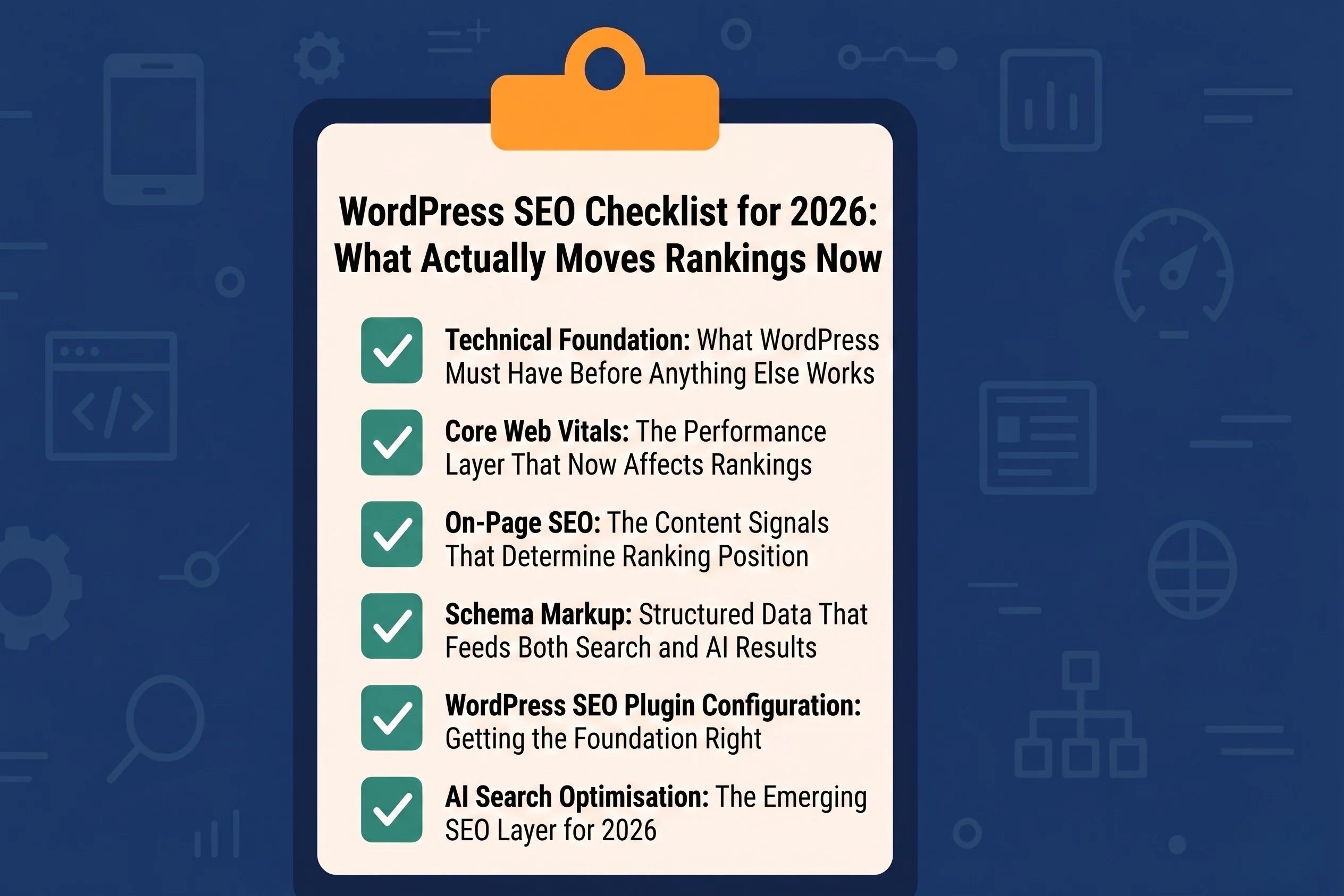
The measurement framework shift requires identifying which business outcome the content program is primarily designed to support, awareness, demand generation, sales enablement, or customer retention, and then selecting metrics that are causally connected to that outcome. On WordPress specifically, the on-page and schema configuration failures that undermine measurement start earlier than most content teams realise – audited systematically in our WordPress SEO checklist for 2026. For demand generation, the relevant metrics are content-sourced leads, content-influenced pipeline value, and cost per content-attributed customer. For sales enablement, the relevant metrics are content usage frequency in the sales process and deal velocity when content is used versus when it is not.
HubSpot’s internal content team tracks a metric called “content-assisted revenue” – the total closed revenue from deals where a prospect consumed at least one piece of content during the evaluation period. This metric captures content’s contribution to the revenue process without requiring the impossible standard of direct attribution for a channel that operates across the full customer journey. Adapting a similar framework to your own CRM data produces a content ROI figure that finance and leadership teams find credible because it is expressed in the language they already use.
Building Topical Breadth Instead of Topical Depth
One of the less obvious content marketing mistakes is the strategic decision to cover many topics at moderate depth rather than fewer topics at genuine depth. This approach feels comprehensive, the content calendar looks full, topics seem diverse, and the team avoids the perceived risk of being too narrow. The algorithmic and commercial outcome is the opposite of what breadth appears to promise.
Google’s Helpful Content system and the entity-based signals feeding AI search results both reward topical authority, the demonstrated expertise of a domain on a specific subject area, evidenced by comprehensive, interconnected coverage of that subject. A website with 200 blog posts across 40 different topics signals general content production. A website with 200 blog posts organised around five topic clusters, each with a pillar page and supporting articles that reference each other, signals expertise in five domains. The second architecture generates substantially more organic search visibility for the same content volume.
The commercial cost of topical breadth without depth is equally significant. Content programs that attempt to serve every stage of every buyer’s journey for every product line simultaneously produce content that is relevant to everyone and memorable to no one. The brands that build content authority, HubSpot in CRM and inbound marketing, Moz in SEO, and Notion in productivity tools, did so by committing to specific topic domains and producing the most comprehensive, useful content available on those topics before expanding.
The corrective action is a topic audit. Map every existing piece of content to a topic cluster. Identify which clusters have sufficient depth to establish genuine authority (typically 15–25 interconnected pieces organised around a pillar) and which are populated by isolated posts that have no structural relationship to each other. Redirect future content investment toward deepening the clusters with the highest commercial relevance before adding new topic areas.
Treating Content as a Campaign Rather Than a Compounding Asset
The final structural mistake shapes how businesses budget for, staff for, and evaluate content marketing programs. When content is treated as a campaign, a time-bounded initiative with a start date, an end date, and a defined budget, it is evaluated on campaign metrics and cancelled or scaled back when those metrics do not meet short-term expectations. This is the wrong mental model applied to a channel with a fundamentally different return structure.
Content is a compounding asset. A well-constructed, well-distributed piece of content can generate qualified traffic, leads, and brand awareness for years after the initial production cost is absorbed. A paid advertisement stops producing returns the moment the budget is cut. The financial profiles of these two channels are structurally different, which means they require different investment frameworks, different evaluation timelines, and different internal stakeholder conversations.
The practical implication is that content marketing budgets should be evaluated on an 18–24 month return horizon for the asset-building component of the program, not on a 90-day cycle. Early-stage content programs will consistently underperform against short-term return expectations, not because they are failing, but because compounding returns require time to accumulate. Businesses that cut or restructure content programs at the six-month mark because they have not yet produced measurable revenue are making a timing error that they typically recognize only in retrospect, when a competitor who maintained their program begins dominating the organic and AI search results in their category.
The internal selling framework for content marketing investment should include leading indicators, organic ranking trajectory, domain authority growth, email subscriber acquisition rate, and backlink velocity, which give stakeholders evidence of program health before conversion data is available. Without these interim signals, content programs are evaluated purely on lagging indicators that take 12–18 months to reflect the quality of early investment decisions.
The Strategic Priority for Brands
The content marketing mistakes outlined here share a common root: they originate in a misunderstanding of what content marketing is and how it creates value. It is not a publishing operation. It is not a social media presence. It is not a volume exercise. It is a system for building brand authority, earning buyer trust, and generating demand over a time horizon that requires patience and measurement discipline that short-term campaign thinking cannot accommodate.
The implementation priority for most businesses is to fix the foundation before scaling the output. Audit your existing content for buyer relevance and search intent alignment. Build a distribution system before publishing another piece. Define outcome-based metrics before your next reporting cycle. Organise existing content into topic clusters before adding new topics. And extend your evaluation horizon before concluding that content marketing does not work for your business.
The direction of content marketing is toward AI-driven discovery, entity-based authority signals, and zero-click brand exposure, all of which reward the same fundamentals that have always defined effective content: specific expertise, genuine usefulness, and consistent investment in serving the audience before asking anything of them in return.