
Brands that publish content consistently without a structural framework account for the majority of social media accounts that stall at 10,000 followers. Content volume is not the constraint – direction is. HubSpot, Patagonia, Duolingo, and Notion have each built substantial audiences on different platforms by organising their content around a small number of clearly defined themes rather than reacting to trending topics or publishing whatever feels relevant that week. The result is audiences that know exactly what to expect, algorithms that learn how to classify and distribute the content, and marketing teams that operate with clarity rather than creative paralysis.
The content pillars framework is the structural solution to the most common social media problem: inconsistency – and operationalising it across calendars, briefs, and platforms is part of how our Kolkata social media markting company runs every retained account. – and operationalising it across calendars, briefs, and platforms is part of how our Kolkata social media team runs every retained account. It gives brands a repeatable architecture for content planning, a basis for platform-specific adaptation, and a measurement system for identifying which themes actually drive business outcomes. This article explains how to build that framework from first principles, how top brands apply it across platforms, and how to connect pillar performance to audience growth and revenue, not just engagement metrics.
What Content Pillars Actually Are (and What They Are Not)
A content pillar is a defined thematic category that represents a consistent area of focus for your brand’s content output. It is not a content format, a campaign theme, or a posting schedule. The distinction matters because conflating pillars with formats leads to frameworks that collapse the moment a platform changes its preferred content type.
A content pillar for a project management software company might be “workplace productivity systems.” Every piece of content that falls under that pillar, whether it is a short-form video, a LinkedIn post, a carousel, or a podcast episode, addresses some aspect of how professionals organise their work. The pillar defines the subject matter, the format is determined by the platform and the available production resources.
Most brands operate effectively with three to five content pillars – and translating those pillars into production-ready creative briefs is the discipline our Kolkata creative team brings to every social engagement. Fewer than three creates monotony; more than five creates the same diffusion problem the framework is designed to solve. The right number is determined by two factors: the breadth of your brand’s authority and the number of distinct audience needs you are trying to serve. A niche B2B software company might sustain three focused pillars. A lifestyle brand with a broader audience might develop five without losing coherence. The wider strategic framework that places pillar selection inside an audience-first plan is in our guide on how to build a social media strategy from scratch in 2026.
Each pillar should satisfy three criteria. First, it must be genuinely relevant to your target audience’s interests or challenges, not just to your product’s features. Second, it must be an area where your brand has credible expertise or a distinctive point of view. Third, it must be broad enough to generate content consistently over months, not just weeks. A pillar that exhausts itself in eight posts is a campaign theme, not a structural foundation.
How Top Brands Structure Their Pillar Systems
Examining how established brands organise their content reveals patterns that smaller businesses can adapt. The common thread is not sophistication, it is clarity. The most effective pillar systems are simple enough that every team member can apply them without a creative brief.
Notion organises its content around three discernible pillars: productivity workflows, Notion-specific tutorials, and creator/entrepreneur stories. Each pillar serves a different stage of the customer relationship, the third builds awareness with non-users, the second supports existing users, and the first positions Notion within a broader conversation about how knowledge workers operate. The framework works because each pillar has a distinct audience intent and a clear connection to the product’s value proposition.
Patagonia built its content architecture around environmental advocacy, product craftsmanship, and outdoor community stories. None of these pillars leads with a sales message, yet all three reinforce the brand’s positioning and consistently attract an audience that converts at high rates. The brand authority generated by the environmental advocacy pillar directly supports the premium pricing that the product pillars monetise.
Duolingo’s social media content operates across humour and entertainment, language learning insights, and community celebration. The humor pillar, which has driven the brand’s viral growth on TikTok, functions as a top-of-funnel awareness engine that has no direct educational content but consistently delivers new users to the other pillars. The framework demonstrates that not every pillar needs to be directly tied to product features; some pillars exist purely to expand reach.
For B2B brands, LinkedIn content pillar systems typically include thought leadership (executive or founder perspective on industry trends), educational content (practical frameworks and how-to guidance), and social proof (customer outcomes, case studies, behind-the-scenes processes). This three-pillar structure maps directly to the awareness-consideration-conversion funnel while maintaining topical coherence across the brand’s entire content output.
Building Your Own Content Pillars: A Practical Framework
The process of defining content pillars starts with audience research, not brand brainstorming. What questions does your target audience regularly ask? What problems do they need solved at different stages of their relationship with your category? What topics do they already engage with on the platforms where you plan to publish? These questions produce audience-derived pillars rather than brand-centric ones, a distinction that significantly affects how content performs in algorithm-driven discovery.
Step one is to audit your existing content performance. If you have been publishing for any length of time, group your best-performing posts by theme. Patterns will emerge that reveal which topics already resonate with your audience before you have consciously optimised for them. These patterns are the raw material for your pillar definitions.
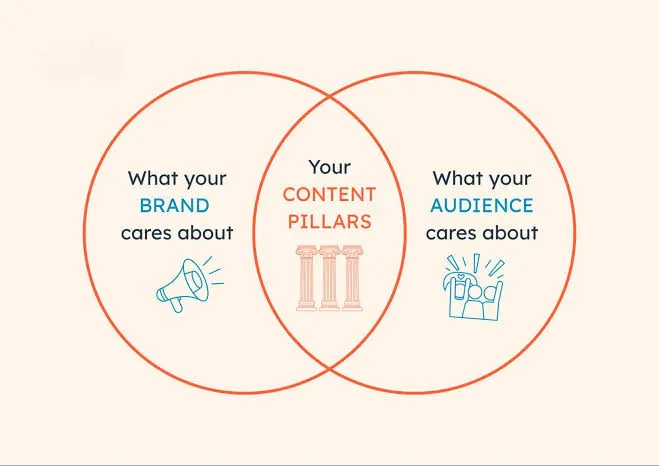
Step two is to map each candidate pillar to a specific audience need and a business objective. A pillar that serves the audience but has no connection to your commercial goals will generate engagement without conversion. A pillar that serves your business but not your audience will underperform algorithmically and feel promotional. The strongest pillars sit at the intersection of genuine audience interest and strategic brand relevance.
Step three is to stress-test each pillar for content volume. Can you generate 20 distinct content ideas within this pillar without repeating yourself? If not, the pillar is too narrow. Can you explain the pillar in one sentence that a new team member would immediately understand? If not, it is too broad. Both tests are quick and prevent framework failures that typically appear three months into execution.
Step four is to assign a platform distribution logic to each pillar. Some pillars are better suited to certain formats and platforms. A pillar focused on behind-the-scenes brand culture tends to perform well on Instagram Stories and TikTok. A thought leadership pillar performs better on LinkedIn and long-form YouTube. A tutorial or educational pillar works across YouTube, Pinterest, and TikTok depending on the complexity of the content. Matching pillar type to platform behaviour improves distribution without requiring separate strategies for each channel.
Platform-Specific Pillar Adaptation
The content pillars framework is platform-agnostic by design, but execution must be platform-specific. The same pillar – say, “customer success stories” – will take a completely different form on TikTok (a 30-second before/after video narrated by the customer), LinkedIn (a structured case study post with specific metrics), Instagram (a visually-led carousel with a testimonial quote), and YouTube (a 5–8 minute documentary-style feature). The pillar stays consistent; the format adapts.
On TikTok, pillar-based content works best when each video is independently accessible – meaning a viewer who has never seen your brand before can watch a single video and immediately understand what you stand for. This is a function of TikTok’s discovery model, where most views come from non-followers. Content that relies on prior brand familiarity underperforms because the algorithm routes it to new audiences by default. Structure each TikTok pillar post to introduce, deliver, and close without assuming context.
On Instagram, pillars translate most effectively into content series – recurring formats that audiences can recognise and anticipate. A weekly “industry insight” post, a recurring tutorial format, or a consistent story series builds habitual engagement that Instagram’s algorithm interprets as audience loyalty, which improves organic distribution over time. The pillar provides the strategic direction; the series format provides the execution structure that builds audience habit.
On LinkedIn, the pillar system should inform both personal and brand account content. Executive accounts amplifying the same pillars as the brand account create a distributed content network that reaches different audience segments while reinforcing a consistent brand narrative. This is particularly effective for thought leadership pillars, where an individual’s voice carries more credibility than a brand account’s.
On YouTube, content pillars map naturally to playlist structures, which are one of YouTube’s primary algorithmic signals for content categorization and recommendation. Organising your channel around three to five playlists – each corresponding to a content pillar – helps YouTube’s system understand what your channel covers and improves the likelihood of recommending your videos to relevant audiences.
Measuring Pillar Performance and Iterating the Framework
A content pillar framework without a measurement system is a creative structure, not a business tool. Pillar performance measurement answers three questions: Which pillars generate the most audience growth? Which pillars drive the most conversion-related behaviour? Which pillars have the highest content production efficiency relative to results?
Audience growth by pillar is measured by tagging all content with its pillar category in your content management system and then correlating publishing periods with follower growth, reach expansion, and new audience acquisition. Most social media management platforms, such as Sprout Social, Later, and Buffer, allow custom tagging that makes this analysis straightforward. Brands that measure at the pillar level consistently discover that one or two pillars drive the majority of their growth, while others maintain audience retention.
Conversion-related behaviour by pillar includes profile visits from pillar-specific content, link clicks from posts within each pillar, saves and shares (which signal purchase intent more reliably than likes), and direct messages initiated by pillar content. Each of these behaviors sits closer to the conversion end of the funnel than engagement rates, which measure attention but not intent.
Content distribution efficiency – the ratio of production time and cost to reach and engagement generated – often reveals that the highest-quality pillar posts are not the highest-performing ones. Short-form video tutorials produced in 30 minutes frequently outperform polished brand videos produced over several days. This is not an argument against production quality; it is an argument for matching production investment to proven pillar performance before scaling costs.
Quarterly pillar reviews, where you assess which pillars are gaining traction, which are stagnating, and whether any new audience needs have emerged, keep the framework responsive without undermining the consistency that makes it valuable. The goal is structured evolution, not reactive reinvention.
What Social Media Leaders Should Do Next
The content pillars framework is not a content calendar, it is a strategic architecture that makes every content calendar decision easier and more coherent. Brands that implement it correctly stop asking “what should we post today” and start asking “which pillar does this serve, and is this the right format for this platform?”
The implementation sequence that works most reliably is: audit existing content to identify latent pillar patterns, define three to five pillars with explicit audience relevance and business connections, assign platform distribution logic to each pillar, build a 90-day content calendar organised by pillar rather than by date, and establish a quarterly review cycle that measures pillar performance against growth and conversion metrics.
Consistency compounds. An audience that knows what to expect from your brand returns more frequently, engages more deeply, and converts at higher rates than an audience kept guessing by a brand that shifts direction with every trending topic. The brands that have built durable social media audiences – Notion, Patagonia, Duolingo, HubSpot, and dozens of others across every category- did so by committing to a framework and executing it with discipline over time.
Social media’s increasing reliance on AI-driven recommendations means that content categorisation signals, the thematic consistency your pillar framework creates, will become more valuable, not less. Platforms are training models to understand what a brand stands for based on content patterns. A clear pillar system gives those models the signal they need to recommend your content to the right audiences at scale.
Pillars give you structural consistency; the next test is whether each pillar earns its production cost – answered in our guide to content marketing ROI.