
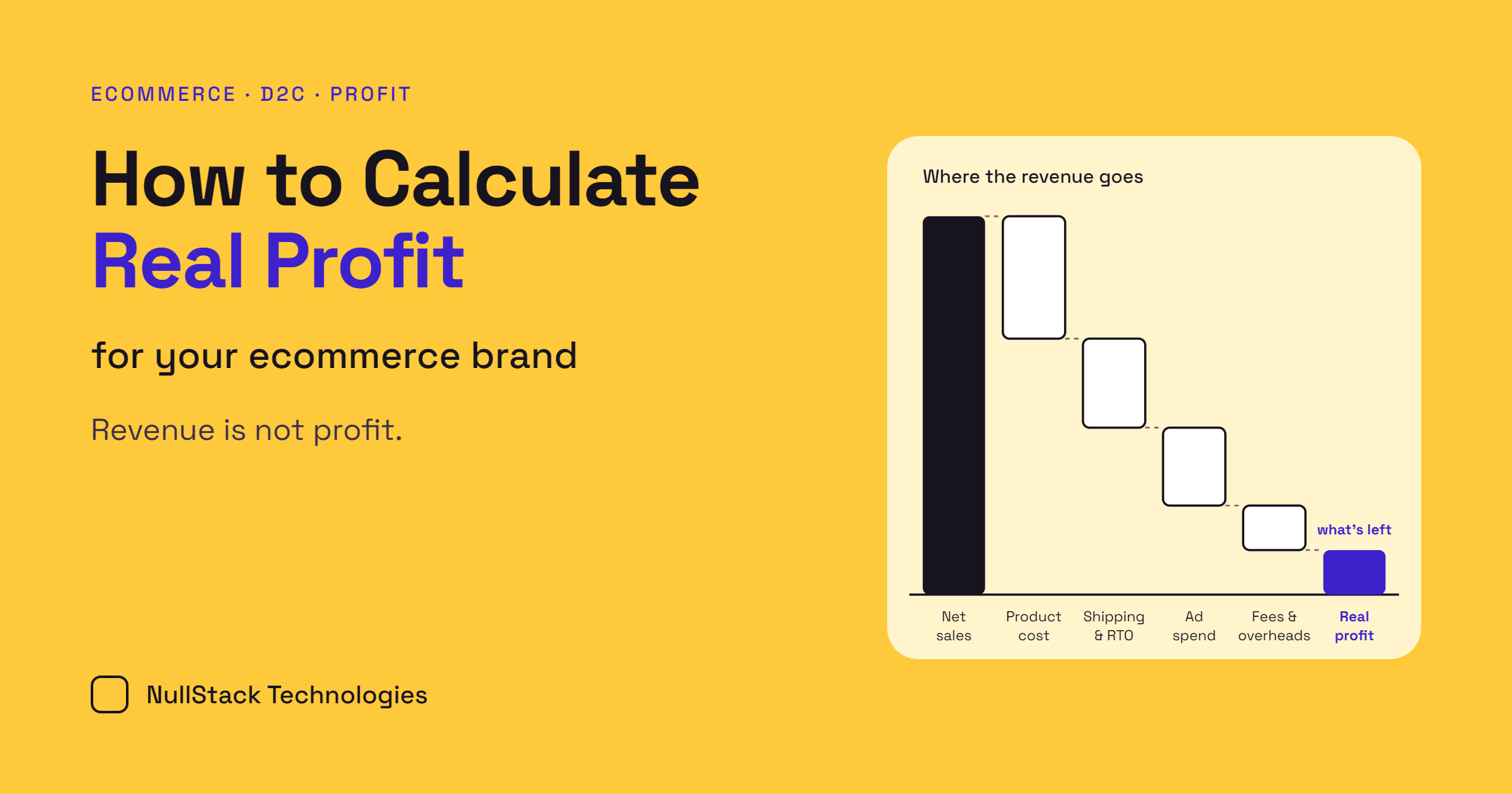
Getting more orders does not always mean your ecommerce business is becoming more profitable. You might generate ₹10 lakh in monthly sales and still struggle to maintain enough cash to pay suppliers, courier partners, advertising bills and other business expenses.
The reason is simple: revenue is not profit.
To understand how your ecommerce brand is actually performing, you need to calculate what remains after accounting for product costs, packaging, shipping, advertising, payment gateway charges, returns, Return to Origin (RTO) losses and operating expenses.
This is particularly important for Indian direct-to-consumer (D2C) brands, where cash-on-delivery orders, courier charges and unsuccessful deliveries can significantly affect profitability.
In this guide, we will explain how to calculate ecommerce profit step by step, understand your real profit margin, evaluate advertising performance and identify the costs that may be reducing your earnings.
What Is Real Profit in Ecommerce?
Real ecommerce profit is the amount your business retains after deducting all applicable costs and expenses from its revenue.
Many sellers calculate profit by subtracting the product cost from the selling price. However, this only gives a partial picture of profitability.
For example, if you sell a product for ₹1,500 and its purchase or manufacturing cost is ₹500, the difference is ₹1,000. But you still need to account for shipping, packaging, advertising, payment processing, returns, salaries, software and other expenses.
Your actual profit can be considerably lower.
There are three important financial measures every ecommerce business should track:
1. Gross Profit
Gross profit is revenue minus the cost of goods sold (COGS).
Formula:
Gross Profit = Net Sales Revenue − Cost of Goods Sold
COGS may include manufacturing or purchase costs and other costs directly attributable to bringing the products into saleable condition, depending on your accounting policy.
Gross profit helps you understand how much you earn from selling products before deducting most selling and administrative expenses.
2. Contribution Profit
Contribution profit is the amount remaining after deducting the costs that vary with sales or orders.
These costs may include product costs, packaging, shipping, payment processing, marketplace fees and advertising, depending on the contribution measure you use.
It helps you determine whether each order contributes enough money toward fixed expenses and profit.
3. Net Profit
Net profit is what remains after deducting all applicable business expenses, including operating overheads and other relevant costs.
Formula:
Net Profit = Total Recognised Revenue − Total Applicable Expenses
For a complete business calculation, also consider interest, depreciation, taxes and other expenses where applicable.
How to Calculate Ecommerce Profit Step by Step
To calculate your ecommerce profit accurately, collect actual figures from your sales reports, courier invoices, advertising dashboards, payment settlements and accounting records.
Step 1: Calculate Your Actual Sales Revenue
Start with the sales revenue your business has earned during the reporting period.
Do not automatically treat every order placed as completed revenue. Cancelled orders, failed deliveries, refunds, discounts and applicable taxes need to be handled correctly.
For example, suppose your store receives 500 orders with an average order value of ₹1,500.
Total order value:
500 × ₹1,500 = ₹7,50,000
This is the gross order value based on the assumed average order value. It is not necessarily your recognised revenue or the amount you will receive in your bank account.
Reconcile it with delivered orders, cancellations, refunds, discounts and applicable GST treatment before using it in your profit calculation.
Step 2: Calculate Your Product Cost
Your product cost is one of the most important parts of ecommerce profitability.
Depending on your business, it can include:
- Manufacturing or supplier purchase cost
- Direct production expenses
- Inbound transportation
- Product-specific quality checks
- Other directly attributable costs
Suppose your product costs ₹450 per unit and you sell 400 units.
Total product cost = 400 × ₹450 = ₹1,80,000
Use a consistent accounting method and avoid counting the same cost twice. If you sell multiple products, calculate their costs separately wherever possible.
Step 3: Include Packaging and Shipping Costs
Shipping is often underestimated when calculating profit.
For each order, consider the applicable expenses for:
- Packaging materials and boxes
- Forward shipping to the customer
- COD handling charges
- Remote-area or additional courier charges
- Reverse shipping for returns
- RTO shipping and handling
For example, if your average forward shipping cost is ₹80 and you dispatch 400 orders, your forward shipping expense is ₹32,000.
However, this does not include the additional expense of unsuccessful deliveries and returned orders.
Use your actual courier invoices rather than relying only on the advertised shipping rate.
Step 4: Calculate Your Advertising Cost Per Order
Advertising can generate sales while reducing profitability if the cost of acquiring customers is too high.
Suppose you spend ₹1,00,000 on advertising and attribute 250 orders to those campaigns.
Advertising cost per attributed order = ₹1,00,000 ÷ 250 = ₹400
This is a basic calculation. To understand your overall business performance, compare it with your total orders, completed orders, new customers and repeat purchases.
You should also distinguish between platform-reported conversions and actual orders in your ecommerce system. Attribution windows, duplicate conversions and cancellations can make advertising dashboards differ from your final sales records.
Step 5: Add Payment Gateway and Marketplace Fees
Depending on where you sell, you may pay:
- Payment gateway processing fees
- Marketplace commissions
- COD collection charges
- Platform transaction fees
- Subscription fees
- Other order-related service charges
For example, if your average payment processing cost is ₹30 per paid order and you have 250 such orders, your total processing cost is ₹7,500.
Do not assume every order incurs the same fee. Prepaid and COD orders can have different cost structures.
Also, treat recoverable GST input tax credit consistently in your calculations. GST charged on an expense is not always an economic expense if the credit is eligible and actually available.
Step 6: Account for Returns and RTO
Returns and RTO are especially important for Indian ecommerce brands.
A return usually means a delivered product comes back from the customer. RTO generally means an order could not be delivered and is returned to the seller.
Both can create costs without generating a completed sale.
For an RTO order, you may incur forward shipping, reverse shipping, COD-related charges and packaging or handling costs. A returned product may be resold, require repackaging or suffer damage.
Consider this example:
You dispatch 100 orders, and 20 become RTO orders. Assume forward shipping costs ₹80 per order and reverse shipping costs ₹80 per RTO.
Forward shipping = 100 × ₹80 = ₹8,000
RTO reverse shipping = 20 × ₹80 = ₹1,600
Total shipping cost = ₹9,600, before any additional handling or product losses.
The ₹1,600 reverse-shipping expense is only one part of the problem. You also need to examine the original shipping costs, packaging expenses and any non-recoverable charges.
Use actual RTO rates and costs from your own order data. Do not apply a generic industry rate to every business.
Step 7: Include Operating Expenses
Even if your orders generate positive contribution profit, your business may still report a net loss.
That is because ecommerce brands also have expenses such as:
- Employee salaries
- Warehouse rent
- Software subscriptions
- Website maintenance
- Accounting and professional fees
- Photography and content production
- Office expenses
- Interest and other financing costs
Allocate expenses to the appropriate reporting period. If you want to compare product profitability, you can also create a management report that allocates shared overhead across products or orders using a consistent method.
A Practical Example: Calculating Ecommerce Profit in India
Suppose an ecommerce brand sells products at an average realised price of ₹1,500 per successful order, excluding GST. For simplicity, assume all 100 orders in this example are successfully delivered and that there are no refunds.
The following figures are illustrative, not industry benchmarks.
| Particulars | Amount |
| Net sales revenue | ₹1,50,00 |
| Product cost | ₹45,000 |
| Packaging | ₹5,000 |
| Forward shipping | ₹8,000 |
| Payment and transaction fees | ₹4,500 |
| Advertising expenses | ₹30,000 |
| Contribution profit | ₹57,500 |
| Operating overheads allocated to the period | ₹20,000 |
| Profit before other expenses and tax | ₹37,500 |
In this example:
Contribution profit = ₹1,50,000 − ₹92,500 = ₹57,500
Profit before other expenses and tax = ₹57,500 − ₹20,000 = ₹37,500
Profit margin before other expenses and tax = ₹37,500 ÷ ₹1,50,000 × 100 = 25%
This is not necessarily the final net profit. Any additional expenses, financing costs, depreciation and applicable taxes still need to be considered.
If some orders become RTO, customers receive refunds, or actual advertising costs rise, the result will change.
The purpose of this example is to demonstrate why a proper profit calculation must include more than product cost and selling price.
How to Calculate Ecommerce Profit Margin
Ecommerce profit margin tells you what percentage of revenue remains as profit.
Formula:
Profit Margin (%) = Profit ÷ Net Sales Revenue × 100
Suppose your net sales revenue is ₹5,00,000 and your net profit is ₹75,000.
Profit margin = ₹75,000 ÷ ₹5,00,000 × 100 = 15%
This means your business retains ₹15 in net profit for every ₹100 of net sales revenue.
Be clear about which margin you are reporting. Gross margin, contribution margin and net profit margin measure different things.
A product with a high gross margin can still produce a low net margin if advertising, shipping and operating expenses are substantial.
Why ROAS Does Not Tell You Your Real Profit
Return on Ad Spend (ROAS) measures the revenue attributed to advertising relative to the amount spent.
Formula:
ROAS = Attributed Advertising Revenue ÷ Advertising Spend
If you spend ₹20,000 on ads and the platform attributes ₹80,000 in revenue, your reported ROAS is 4x.
That means the platform attributes ₹4 in revenue to every ₹1 spent on advertising.
It does not mean your business earns ₹4 in profit.
You still need to deduct product costs, GST where applicable, packaging, shipping, payment fees, returns, RTO and operating expenses.
To understand whether a campaign is profitable, evaluate ROAS alongside contribution margin, actual customer acquisition cost, completed orders and the amount of revenue retained after costs.
Calculate Your Break-Even ROAS
Break-even ROAS is the advertising return required to cover advertising spend, based on the margin available before advertising.
A simplified formula is:
Break-Even ROAS = 1 ÷ Pre-Ad Contribution Margin Ratio
If your contribution margin before advertising is 40%, your simplified break-even ROAS is 1 ÷ 0.40 = 2.5x.
This calculation assumes the contribution margin is measured against the same revenue base used for ROAS and includes all relevant non-advertising variable costs. Your actual break-even point may be different if you have returns, RTO, taxes or other costs that are not reflected in that margin.
How to Improve Your Ecommerce Profitability
Once you know where your money is going, focus on improving the economics of your orders rather than increasing sales alone.
Reduce Unnecessary RTO Costs
Analyse RTO rates by payment method, product, courier, destination and customer segment. Confirm addresses, improve delivery communication and test suitable prepaid incentives where commercially appropriate.
Track whether these measures improve delivered-order profitability, not just the number of orders placed.
Improve Average Order Value
Product bundles, complementary products and sensible free-shipping thresholds can increase order value.
However, calculate the additional product, packaging and shipping costs before offering a bundle or discount.
Control Customer Acquisition Costs
Review campaigns against completed sales and contribution profit. Pause or revise campaigns that consistently acquire unprofitable orders, while allowing for attribution delays and repeat-purchase economics.
Review Pricing and Discounts
Check whether your selling price covers the full cost of delivering and supporting the order. Include promotional discounts and coupon usage in your actual realised revenue.
A higher selling price is not automatically better if it significantly reduces conversion rates.
Monitor Profit by Product and Channel
Calculate profit separately for important SKUs, marketplaces and your own website. Their commissions, shipping rates, customer behaviour and return rates may differ.
This helps you identify which products and channels deserve more investment.
Review Profit and Cash Flow Separately
Profitability and cash flow are related, but they are not identical.
You may report a profit while waiting for COD remittances or marketplace settlements. You may also have cash in the bank because of supplier credit or customer advances even when the business is losing money.
Review your profit-and-loss statement alongside cash flow, inventory and outstanding settlement reports.
Common Ecommerce Profit Calculation Mistakes
Avoid these common mistakes when reviewing your numbers:
- Treating total order value as completed sales revenue.
- Calculating profit using product cost alone.
- Ignoring advertising expenditure.
- Excluding RTO and reverse-shipping costs.
- Mixing GST-inclusive sales with GST-exclusive costs.
- Counting payment fees or shipping costs twice.
- Treating platform-reported ROAS as net profit.
- Ignoring refunds, discounts and damaged inventory.
- Forgetting fixed overheads when calculating net profit.
- Confusing bank settlements with accounting revenue.
The solution is to maintain a consistent reporting method and reconcile your ecommerce platform, courier, advertising, payment and accounting data every month.
Final Thoughts
Calculating real ecommerce profit requires a complete view of the money coming in and the costs required to generate and fulfil each sale.
Start with actual net sales revenue, calculate product and fulfilment costs, account for advertising and transaction fees, include returns and RTO, and deduct operating overheads to determine the business’s final profitability.
For Indian D2C brands, understanding the cost of COD orders and failed deliveries can be particularly important. A brand that tracks contribution profit, break-even ROAS, net margin and cash flow can make more informed decisions about pricing, marketing and growth.
The objective is not simply to generate more orders. It is to build an ecommerce business where sales consistently contribute to sustainable profit.