Key takeaways
- AI-powered search changes how shoppers ask questions and how answers are assembled, but Google says existing SEO fundamentals still apply to its AI features.
- A page must be indexed and eligible to appear with a snippet before it can be used as a supporting link in AI Overviews or AI Mode.
- Complete, accurate product data (on the page, in structured data and in your Merchant Centre feed) is the foundation of modern product discovery.
- Generative Engine Optimisation (GEO) and Answer Engine Optimisation (AEO) are best treated as extensions of good SEO, not shortcuts to guaranteed citations.
- Traffic only matters if it converts, so pair SEO with conversion rate optimisation and retention.
A shopper who once typed “running shoes” now asks something closer to “which running shoes suit flat feet and long runs on tarmac?” Search engines and AI assistants respond by breaking that question into smaller searches, pulling product information from several places and assembling an answer. If your store’s information is thin, inconsistent or hard to crawl, you may never be part of that answer.
That is why eCommerce SEO in the AI era is less a brand-new discipline than a more demanding version of the old one. Google’s own guidance for site owners says that specific optimisation isn’t required for AI Overviews and AI Mode, and that the existing SEO fundamentals remain worthwhile. What has changed is the cost of doing those fundamentals badly: weak product data, slow pages and generic copy now hurt you in more places than one.
This eCommerce SEO guide is written for store owners, D2C brands, marketing managers and anyone planning to launch or scale an online store on Shopify, WooCommerce or a custom platform. It covers what is changing, what is not, and what to do about it in a practical 90-day plan. Throughout, we label practices as Established (long-standing and documented by search engines) or Emerging (still evolving, so treat them as experiments rather than guarantees).
How AI Is Changing Product Discovery
Product discovery used to mean a short keyword and a page of ten blue links. Today it happens in several places at once: classic search results, AI Overviews, AI Mode, shopping panels, marketplaces and AI assistants such as ChatGPT, Gemini and Copilot. Shoppers move between them, often within a single buying journey.
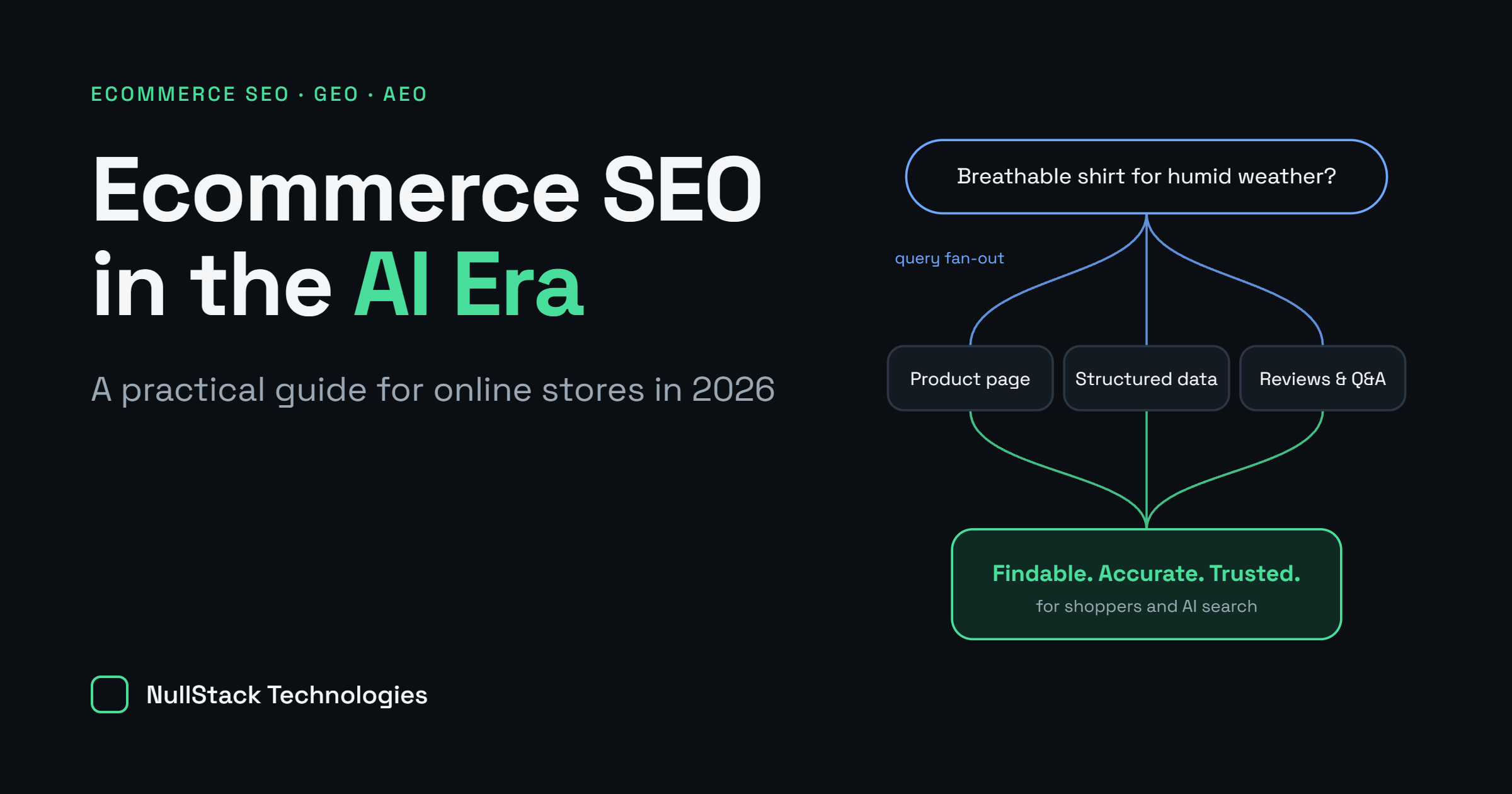
Google explains that both AI Overviews and AI Mode may use a “query fan-out” technique, issuing several related searches across subtopics and data sources before composing a response (Google Search Central). For an online store, that means one shopper question can trigger many retrieval steps. You need to be findable for the sub-questions (fabric, fit, ingredients, compatibility, delivery, returns), not just the head term.
Commerce itself is also moving closer to the conversation. In January 2026, Google announced the Universal Commerce Protocol (UCP), an open standard for agentic commerce, and in May 2026 it introduced Universal Cart and new Merchant Centre tools (Google, May 2026). Availability is staged by market and merchant eligibility. For example, Google said UCP-powered checkout would roll out in Canada and Australia in the coming months, then in the UK, and that its AI performance insights tool in Merchant Centre would reach merchants in India and other markets over time. Treat these as developments to prepare for, not tactics to bet the business on.
What has not changed (Established). To be shown as a supporting link in AI Overviews or AI Mode, Google says a page must be indexed and eligible to appear in Search with a snippet. It also says there is no special schema.org markup you need to add for AI features. In other words, crawlable, indexable, genuinely useful pages remain the entry ticket.
Traditional eCommerce SEO vs AI-Era Search Optimisation
The two approaches overlap heavily. The difference is mostly in emphasis:
- Goal. Traditional SEO aims to rank pages for keywords. AI-era optimisation aims to make your products retrievable, understandable and trustworthy wherever answers are assembled: classic results, AI summaries, shopping surfaces and assistants.
- Queries. Short keywords (“linen shirt”) are joined by long, multi-constraint questions (“breathable shirt for humid weather that doesn’t need ironing”).
- Unit of content. The page is still the unit that gets indexed, but individual passages, product attributes and feed entries increasingly shape what gets surfaced.
- Data. On-page copy matters as before. Structured data, feeds and catalogue completeness now carry more weight in shopping experiences.
- Measurement. Rankings and clicks remain central, but impressions in AI features, brand search demand and assisted conversions add useful context.
- Constants. Fast, mobile-friendly, honest, well-organised sites that answer real questions still win the long game.
A useful rule: if a tactic makes sense only for an AI system and does nothing for a human shopper, be sceptical.
Start With Search Intent and the Customer Journey
Search intent is the reason behind a query. Mapping it stops you from forcing every keyword onto a product page. Four types matter most for retail:
- Informational: “how to choose a moisturiser for oily skin.” Best served by guides, comparisons and explainers.
- Commercial investigation: “best laptops for video editing.” Served by comparison pages, buying guides and category pages with strong filters.
- Transactional: “buy cotton bedsheet king size.” Served by product and category pages.
- Navigational: a brand or store name. Served by a clear homepage and consistent brand signals.
Now place those intents along the journey: awareness, consideration, purchase and post-purchase. Take a hypothetical D2C skincare brand. At awareness, shoppers ask what ingredients suit sensitive skin. At consideration, they compare serums. At purchase, they check price, delivery and returns. After purchase, they search for how to use the product. Each stage deserves a page type built for it, linked to the next stage so a reader can move forward naturally.
Keyword Research for Traditional and Conversational Queries
Traditional keyword research (Established) still starts with demand: what people search for, how competitive it is, and which pages could realistically rank. Group keywords by topic and intent, not as a flat list, and assign each group to one page.
Conversational research (Emerging) adds the language shoppers actually use when they are unsure. Good sources include:
- Search Console queries, especially long ones that already trigger impressions.
- Customer support chats, emails and pre-sale WhatsApp questions.
- Product reviews and return reasons, which reveal what buyers wish they had known.
- On-site search terms, particularly searches that return no results.
- Sales team call notes and marketplace Q&A sections.
Examples of the shift, by vertical:
- Fashion: “wedding guest saree that’s light to carry” rather than only “designer saree.”
- Beauty: “fragrance-free sunscreen for acne-prone skin” rather than “sunscreen.”
- Electronics: “power bank that can charge a laptop on flights” rather than “power bank.”
- Home products: “storage bed for a small bedroom” rather than “bed.”
Long-tail phrases such as “Shopify SEO for small stores” or “WooCommerce SEO for large catalogues” are valuable, but write for the question behind them. Repeating a phrase unnaturally helps nobody and reads badly.
Product Pages, Category Pages and Image SEO
Product page SEO
Product page SEO is where most eCommerce revenue is won or lost. Each product page should clearly answer: what is it, who is it for, what does it cost, is it in stock, how soon will it arrive and what if it doesn’t work out.
- Titles and headings: include the product name and the attribute shoppers use to choose (size, material, model number), written for people first.
- Unique descriptions: avoid pasting manufacturer copy used by every other retailer. Describe fit, use cases, care, materials and limitations in your own words.
- Vertical-specific detail: fashion needs size charts and fabric behaviour; beauty needs ingredients and skin-type guidance; electronics need compatibility and specifications; home products need exact dimensions, weight and assembly information.
- Variants: make sure colour and size variants are handled cleanly, without creating thin duplicate pages.
- Reviews and Q&A: genuine customer content adds the real-world detail that copywriters can’t invent.
- Policies: show shipping and return information close to the buy button.
Category page SEO
Category pages often target your highest-volume commercial terms. Give them a short, useful introduction, logical subcategories, helpful filters and links to buying guides. Be careful with faceted navigation (filters that generate many URL combinations): let valuable combinations be indexed deliberately and keep the rest from flooding the index.
Image SEO
Images sell products and also feed Google Images and visual search. Use descriptive file names, accurate alt text, responsive sizes and modern formats. Don’t lazy-load the main product image that appears above the fold, because that can slow your Largest Contentful Paint. If you use AI-generated product images, Google’s guidance notes that Merchant Centre has policies for them, including IPTC DigitalSourceType metadata.
Technical SEO: Crawlability, Speed and Site Architecture
Ecommerce technical SEO is the plumbing that lets everything else work. These are established practices, and they matter for AI features too, since eligibility depends on being indexed.
Crawlability and indexability
Crawlability means search engines can reach your pages. Indexability means they can store and show them. Check your robots.txt, XML sitemap, canonical tags and noindex rules. Make sure important product and category pages return a normal 200 status, that discontinued products are redirected or handled sensibly, and that internal search results and endless filter URLs aren’t consuming crawl attention. If key content only appears after heavy JavaScript runs, test how it renders.
Mobile usability and Core Web Vitals
Most shopping happens on phones, so mobile experience is the baseline. Core Web Vitals are Google’s real-user performance metrics. The “good” thresholds, assessed at the 75th percentile of visits, are Largest Contentful Paint (loading) of 2.5 seconds or less, Interaction to Next Paint (responsiveness) of 200 milliseconds or less, and Cumulative Layout Shift (visual stability) of 0.1 or less (web.dev). Heavy themes, oversized images, chat widgets and tracking scripts are the usual culprits when stores miss them.
Site architecture
Keep the structure logical and shallow: homepage, categories, subcategories, products. Use breadcrumbs, descriptive URLs and consistent navigation so both shoppers and crawlers can see how products relate.
Platform notes: Shopify and WooCommerce
Shopify SEO benefits from solid defaults, such as automatically generated sitemaps and canonical handling for products reached through collection URLs. Most problems come from apps and theme code that add scripts, duplicate content or slow rendering. WooCommerce SEO offers more control but more responsibility: hosting quality, caching, plugin choices, and how attribute, tag and filtered archives are indexed. On either platform, fewer well-chosen apps or plugins usually beat many overlapping ones.
Structured Data, Merchant Centre Feeds and Accurate Product Information
Structured data is code that labels the facts on a page so machines can read them without guessing. For stores, Google describes two main classes of product markup: product snippets for pages where a product can’t be bought directly, and merchant listings for pages where it can (Google Search Central). Google also says that providing both on-page structured data and a Merchant Centre feed maximises eligibility and helps it verify your data.
In practice, structured data for eCommerce should cover:
- Product details: name, images, description, brand, identifiers such as GTIN where they exist.
- Offers: price, currency and availability that match what the visitor sees.
- Reviews and ratings: only where they genuinely appear on the page.
- Policies: Google recommends marking up business-level policies, such as return policies, under Organisation markup.
The golden rule is consistency. Price, stock and shipping in your markup, your feed and your visible page should agree. Mismatches can cause disapproved products, lost eligibility and, worse, frustrated customers.
Google has also introduced conversational attributes in Merchant Center, which let retailers update product descriptions to reflect the more conversational way people search (Google, May 2026). Shopify has likewise been extending its Catalogue and “Agentic Storefronts” features to syndicate product data to AI channels, with eligibility and rollout varying by region, so check your admin and Shopify’s Help Centre for what applies to your store. The common thread is that clean, complete product data is becoming the raw material of AI shopping.
Generative Engine Optimisation and Answer Engine Optimisation
Answer Engine Optimisation (AEO) means structuring content so it can be used to answer direct questions. Generative Engine Optimisation (GEO) extends that idea to generative systems such as AI Overviews, AI Mode and chat assistants. Together they are often called AI search optimisation.
Be clear-eyed about them. No one can promise that an AI system will cite your store, and Google says no special optimisation is required for its AI features. These approaches are best understood as a disciplined way of doing good SEO in a world of generated answers (Emerging, built on Established foundations):
- Answer first. Put the direct answer near the top of a guide, then add nuance. Short, accurate paragraphs are easier for people and systems to use.
- Cover the sub-questions. Because of query fan-out, a page that addresses the follow-up questions around a topic is more useful than a thin one.
- Be specific and verifiable. Exact dimensions, materials, compatibility and policies beat vague marketing language.
- Make your brand a clear entity. Consistent business name, contact details, about page and profiles help systems and shoppers understand who you are.
- Keep pages accessible. Don’t block important pages from crawlers by accident, and make sure content isn’t hidden behind interactions.
- Test realistically. Try nuanced shopper-style prompts about your category and note where you appear, but track trends over time rather than treating a single result as proof.
For measurement, Google launched Search Generative AI performance reports in Search Console on 3 June 2026. They show impressions within generative AI features such as AI Overviews and AI Mode, and the data also remains in the main Performance report. Availability has been rolling out, so check whether the report appears for your property.
Helpful Content, First-Hand Experience and Trust Signals
Search systems and shoppers reward content that shows real knowledge. For stores, E-E-A-T (experience, expertise, authoritativeness and trustworthiness) is mostly about proof:
- First-hand experience: photos and videos of real products in use, fit notes from the team that has handled the garments, tested in-house comparisons for electronics.
- Expertise: guides written or reviewed by people who understand the category, such as a trained fitter, a qualified skincare professional for ingredient explainers, or an engineer for technical specifications.
- Original research: anonymised insights from your own sales, returns and support data, such as which size questions come up most or what customers misunderstand about a product.
- Trust signals: visible contact details, clear shipping and returns, secure checkout, an honest about page and genuine reviews. Never fabricate or incentivise misleading reviews.
- Accountability: name authors and reviewers on guides, and update pages with dates when facts change.
This is where an experienced store has an advantage over a generic content farm. You know your customers’ real questions, so answer them better than anyone else.
Internal Linking, Topical Authority and Digital PR
Internal links tell search engines which pages matter and how topics connect. Link buying guides to the categories they support, categories to best-selling products, and products back to relevant guides. Use descriptive anchor text and avoid orphan pages that no other page links to. Google lists making content easy to find through internal links among the fundamentals that still matter for AI features.
Topical authority means covering a subject area thoroughly enough to be a dependable source. A home-furnishing store, for instance, might build a cluster around small-space living: category pages, measuring guides, material comparisons and care instructions, all interlinked. Depth beats volume: ten excellent, connected pages outperform a hundred thin ones.
Digital PR and backlinks remain important authority signals. Earn them with things worth citing: original data, useful tools such as a size calculator, expert commentary, and genuine brand stories. Pursue relevant editorial coverage and partnerships rather than buying links or joining link schemes, which breach Google’s spam policies.
AI-Assisted Content and Automation, With Humans in the Loop
AI can speed up eCommerce content work: drafting product description variants, summarising reviews, spotting catalogue gaps, generating alt text drafts or routing repetitive tasks. Google’s guidance says generative AI can be useful for researching topics and adding structure to original content, but that using it to generate many pages without adding value for users may violate its spam policy on scaled content abuse. AI content is not penalised simply because it is AI-assisted. The risk is low-value content produced at scale.
A safe workflow looks like this:
- Start from a verified product data source, not from the model’s memory.
- Let AI draft, then have a person edit for accuracy, tone and usefulness.
- Fact-check specifications, ingredients, sizing and any claim that could mislead, especially in regulated categories such as beauty and health.
- Add original value: real photos, first-hand notes, genuine reviews.
- Spot-check regularly and keep an audit trail of what was automated.
Automation also helps beyond copy. You can automate inventory synchronisation, feed updates, review requests, and abandoned-cart flows, provided someone monitors errors. NullStack Technologies builds AI and automation systems with process auditing first, because automating a broken process only produces broken results faster.
Conversion Rate Optimisation, Checkout and Retention
Organic visitors who can’t find, trust or buy a product don’t help the business. eCommerce conversion rate optimisation (CRO) turns search traffic into revenue:
- Product discovery on-site: fast site search with typo tolerance, sensible filters and sorting, and helpful “no results” pages.
- Product pages: clear photography, honest reviews, size or compatibility guidance, stock and delivery estimates.
- Checkout: fewer form fields, guest checkout, clear total cost before the final step and the payment methods local shoppers expect (for many Indian shoppers, that includes UPI and cash on delivery).
- Trust: visible returns policy, secure payment indicators and responsive support.
- Retention: post-purchase emails or WhatsApp messages, replenishment reminders for consumables, review requests and loyalty mechanics. Repeat customers lower your dependence on paid acquisition and generate the reviews that strengthen future SEO.
Test changes properly. Use one hypothesis at a time, run tests long enough to be meaningful and judge them on revenue per visitor, not just clicks.
A Practical 90-Day eCommerce SEO Action Plan
This plan suits a store with an existing catalogue. Adjust the pace to your team’s capacity and platform.
Days 1–30: Audit and fix the foundations
- Verify Search Console, GA4 and Merchant Centre, and connect them properly.
- Crawl the site and list indexing, canonical, redirect and duplicate-content issues.
- Check Core Web Vitals field data for your key templates (home, category, product, cart, checkout) and note the biggest bottlenecks.
- Audit product data: missing identifiers, inconsistent prices, thin descriptions, wrong availability.
- Choose 20 to 50 priority products and categories based on margin, demand and current visibility.
- Review robots.txt, sitemaps and how filters and variants are indexed.
Days 31–60: Build and improve
- Rewrite or enrich priority product and category pages with unique, specific copy and better images.
- Implement or correct Product, Offer and Organisation structured data, then validate it with Google’s tools.
- Fix Merchant Centre feed errors and enrich attributes, including conversational detail where available.
- Publish two to four buying guides or comparison pages that answer real customer questions, each linked to the relevant categories.
- Improve internal linking between guides, categories and products.
- Begin speed work: image compression, script clean-up, theme and app review.
Days 61–90: Scale and measure
- Expand optimisation to the next batch of products and categories.
- Start a review-collection and Q&A programme to build first-hand content.
- Launch a small digital PR or content-asset project, such as original data or a size guide worth citing.
- Review Search Console, including the generative AI report if available, and compare against your day-one baseline.
- Test two or three CRO improvements on high-traffic pages.
- Document what worked, retire what didn’t and plan the next quarter.
SEO compounds over time. Many technical fixes show up in weeks, but meaningful organic growth usually takes longer and varies with competition, site history and execution.
Key Performance Indicators and Tools for Measuring Success
KPIs to track
- Organic revenue, orders and conversion rate (separate branded from non-branded traffic).
- Non-brand organic impressions, clicks and average position for priority categories.
- Indexed, valid product pages compared with the number you submitted.
- Core Web Vitals pass rate based on field data, by template.
- Merchant listing and product snippet validity, plus feed approval rates.
- Impressions in AI features from Search Console’s generative AI report, where available.
- Revenue per organic session and assisted conversions.
- Review volume and average rating; on-site search no-result rate.
- Branded search demand over time, as a signal of growing awareness.
Tools
- Google Search Console and Bing Webmaster Tools for visibility and indexing.
- Google Analytics 4 and Looker Studio for behaviour and revenue reporting.
- Google Merchant Centre for feeds and product diagnostics.
- PageSpeed Insights, Lighthouse and the Chrome UX Report for performance.
- Google’s Rich Results Test for structured data checks.
- A site crawler such as Screaming Frog and a keyword or competitive tool such as Semrush or Ahrefs.
Common eCommerce SEO Mistakes to Avoid
- Copying manufacturer descriptions across hundreds of products.
- Letting filters create endless indexable URLs that dilute crawl attention.
- Mismatched data: prices or stock in markup or feeds that differ from the page.
- Ignoring mobile performance and judging speed only on a fast office connection.
- Mass-producing AI content without review, sources or added value.
- Chasing AI-citation tricks while neglecting crawlability and content quality.
- Adding too many apps or plugins that slow the store.
- Treating out-of-stock or discontinued products carelessly, leaving dead ends or soft 404s.
- Publishing blog posts disconnected from products, with no internal links to categories.
- Measuring only rankings, not revenue, conversion or retention.
Conclusion: Build for Shoppers, and the Systems Will Follow
The most useful way to think about eCommerce SEO in 2026 is as product-information quality. A fast, crawlable store with complete product data, honest expertise and a smooth checkout is well placed whether a shopper arrives from a classic result, an AI Overview or an assistant. The strategies above will not guarantee any particular ranking or citation, but they raise the odds that your store is findable, believable and easy to buy from.
If you would like help putting this into practice, NullStack Technologies works with online retailers on eCommerce development across Shopify and WooCommerce, technical SEO and digital marketing, structured data implementation and AI-enabled automation. We typically begin with an audit of your crawlability, Core Web Vitals, product data and conversion path, then agree a prioritised roadmap. To discuss your store, get in touch with NullStack Technologies.
Frequently Asked Questions
What is eCommerce SEO in the AI era?
It is the practice of making an online store easy for search engines, AI features, and shoppers to find, understand and trust. It builds on traditional SEO (technical health, helpful content, authority) and adds attention to complete product data, conversational queries and measurement in AI search features.
Is SEO still relevant with AI Overviews and AI Mode?
Yes. Google states that existing SEO fundamentals continue to be worthwhile for its AI features, and that pages must be indexed and snippet-eligible to appear as supporting links. AI changes how results are presented, not the need to be discoverable and useful.
What is the difference between SEO, AEO and GEO?
SEO aims to improve visibility in search results broadly. AEO focuses on structuring content to answer direct questions clearly. GEO focuses on being useful to generative systems that compile answers. In practice, they share the same foundations: accessible, accurate, well-organised, trustworthy content.
Do I need special schema markup to appear in AI answers?
No. Google says there is no special structured data required for its AI features. Standard Product, Offer and Organization markup is still worth implementing because it supports product snippets, merchant listings and accurate understanding of your products.
Is Shopify or WooCommerce better for SEO?
Both can perform well. Shopify offers strong defaults and simpler maintenance. WooCommerce offers more flexibility but needs careful hosting, caching and plugin management. The better choice depends on your catalogue size, budget, technical resources and growth plans.
Can I use AI to write product descriptions?
Yes, with oversight. Google does not penalise content simply for being AI-assisted, but mass-produced pages that add no value can breach its scaled content abuse policy. Use verified product data, have a person review and fact-check every description, and add real details such as fit, use and care.
How long does eCommerce SEO take to work?
There is no fixed timeline. Technical fixes can show effects within weeks, while competitive category rankings often take months. Results depend on your starting point, competition and consistency, and nobody can honestly guarantee rankings, AI citations or revenue.