Shopify processed over $235 billion in gross merchandise volume in 2024, and a growing share of that commerce is being influenced by AI systems embedded directly into the platform, not as experimental add-ons, but as operational tools built into the merchant dashboard, the checkout flow, and the customer-facing storefront. Shopify has invested more heavily in AI infrastructure than any other e-commerce platform over the past two years, integrating generative and predictive capabilities across its product surface under the Shopify Magic and Sidekick product lines.
For store owners, the practical question is not whether AI matters in e-commerce, it clearly does, but which Shopify AI features are production-ready, which deliver measurable returns, and which require evaluation against your specific business model before adoption The answer varies by store size, catalogue complexity, and operational maturity. But several AI capabilities within the Shopify ecosystem have reached a level of reliability and practical value that makes adoption a straightforward operational decision rather than an experimental one. – a decision framework our Shopify website development services in Kolkata apply on every new store implementation.
Shopify Magic: AI-Generated Content Across the Merchant Dashboard
Shopify Magic is the umbrella product name for Shopify’s generative AI capabilities embedded directly into the merchant admin. It surfaces across product descriptions, email subject lines, blog content, storefront page copy, and customer support response templates, reducing the time merchants spend on content production without requiring a third-party AI subscription.
The product description generator is the most widely used of Shopify Magic’s features. Merchants input a product name, key attributes, and a target tone, and the system generates a complete product description formatted for the Shopify product editor. For stores with large catalogues, this capability has a compounding operational value: writing 500 product descriptions manually is a significant content production investment; generating and editing 500 AI-drafted descriptions reduces that investment by 60–70% for most merchants without degrading description quality when basic input is provided.
The practical limitation is that Shopify Magic generates descriptions from the inputs you provide, it does not research your product independently. Merchants who provide minimal inputs receive generic outputs. The feature works best as an acceleration tool for merchants who know their product well and want to convert that knowledge into formatted copy quickly, not as a replacement for product expertise.
Shopify Magic also generates email subject line suggestions within Shopify Email, the platform’s native email marketing tool. The system analyzes the email body content and suggests subject lines calibrated for open rate performance. For merchants who use Shopify Email as their primary email tool rather than Klaviyo or Omnisend, this reduces the cognitive load of email production without requiring a separate AI writing subscription.
Shopify Sidekick: Conversational Commerce Operations
Shopify Sidekick is the most strategically significant of the Shopify AI features launched in the current product cycle, and it reflects Shopify’s positioning as a complete commerce operating system rather than a shopping cart – a positioning fully unpacked in our breakdown of what Shopify is and why it remains the most reliable e-commerce platform for growing brands. It is a conversational AI assistant embedded in the merchant admin that allows store owners to query their store data, request operational actions, and receive strategic recommendations through a natural language interface, without managing through the admin dashboard manually.
Practical use cases that Sidekick handles include: pulling a sales performance summary for a specific date range, identifying which products have the highest return rates in the last 30 days, generating a discount code with specific parameters, and explaining why a particular metric has changed. For merchants who spend meaningful time each week navigating analytics dashboards and performing repetitive admin tasks, Sidekick compresses that time into direct queries.
The more valuable application is decision support. A merchant who asks “which of my products have been out of stock for more than three days this month and how much revenue did I likely lose?” receives an answer that previously required a custom report or a manual spreadsheet pull. This type of query, combining inventory data with revenue projections, is exactly where AI-assisted data synthesis adds genuine operational value over manual reporting.
Sidekick’s current limitations are worth acknowledging. It operates within the data Shopify has access to, your store’s orders, products, customers, and inventory. It cannot pull data from third-party apps, your Google Analytics account, or your external ad platforms unless those are natively connected to Shopify. For merchants whose operational picture requires synthesis across multiple platforms, Sidekick provides partial answers that require supplementation from other dashboards.
AI-Powered Product Discovery and Search
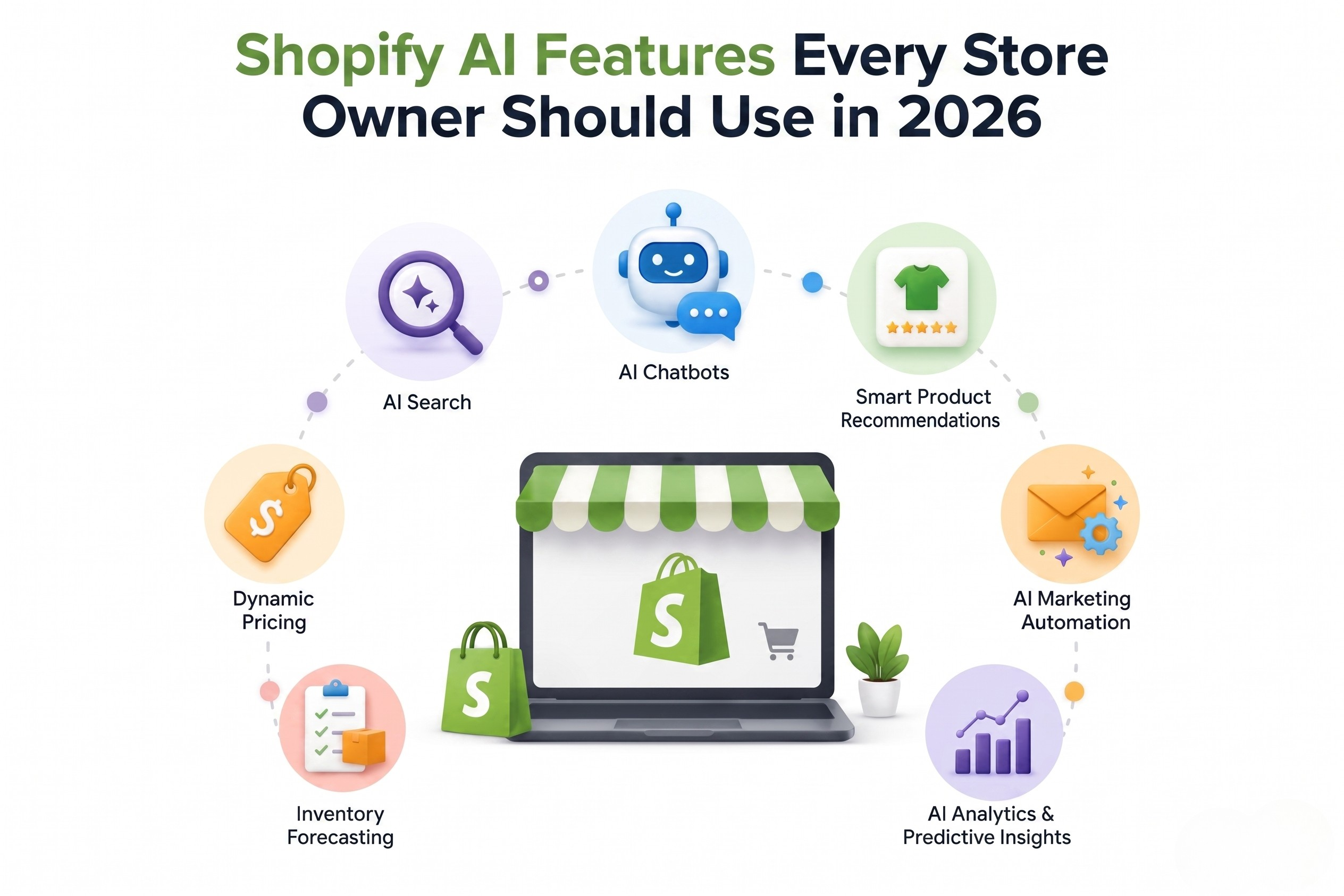
Shopify Search and Discovery, the platform’s native search and product recommendation system, has incorporated AI-powered semantic understanding that meaningfully improves the buyer experience for stores with mid-to-large catalogs. The traditional search model matched buyer queries against product titles and descriptions through keyword matching, a buyer searching “lightweight summer dress” would only surface products containing exactly those words. The AI-enhanced model understands intent and context, surfacing products that match the underlying query meaning even when the exact keywords are absent from the product listing – a shift that mirrors what our SEO experts in Kolkata are already engineering into product-page content to earn visibility in Google’s AI-mediated search results.
For store owners, this translates into measurable search conversion rate improvements for stores where buyers frequently use natural language queries or category-level searches rather than exact product names. Shopify’s internal data indicates that stores using the upgraded Search and Discovery app see meaningful improvements in search result click-through rates and post-search conversion rates relative to keyword-only search, particularly for apparel, home goods, and beauty categories where buyer vocabulary varies significantly from merchant product naming conventions.
The AI recommendation engine within Search and Discovery also powers “frequently bought together,” “you may also like,” and “recently viewed” modules through behavioural analysis rather than manual curation. For merchants who previously managed recommendation logic manually or relied on third-party recommendation apps, the native system reduces app stack complexity while delivering personalisation at a level that manual curation cannot match at scale.
Configuring the Search and Discovery app correctly requires intentional product tagging and metafield completion. The AI system learns from the data you provide, products with complete attributes, accurate categorisation, and descriptive tags surface in relevant searches more reliably than products with minimal metadata. The investment in catalog data quality pays dividends in search performance that compounds as the recommendation system learns from buyer behaviour on your store.
AI in Shopify Email and Marketing Automation
Shopify’s native marketing tools have incorporated AI capabilities that reduce the production overhead of running email and automation programs without requiring the complexity of enterprise marketing automation platforms. For merchants who want to run effective email marketing without a dedicated marketing operations resource, these features close a significant capability gap. The broader playbook for turning email from a broadcast tool into a triggered revenue system is in our guide to email marketing in 2026.
The segmentation AI within Shopify Email analyzes customer purchase history, browsing behavior, and engagement patterns to suggest audience segments for specific campaigns. Rather than manually building segment conditions, “customers who purchased in category X but not Y, with LTV above Z, who last purchased more than 60 days ago,” merchants can describe the audience they want to reach in natural language, and the system generates the segment logic. This reduces the technical barrier to running behavior-based email campaigns that previously required marketing automation expertise.
Shopify Flow, the platform’s automation builder available on Advanced and Plus plans, has added AI-assisted workflow creation that converts plain language automation descriptions into functional workflow logic. A merchant who wants to “automatically tag customers as VIP when their total spend exceeds ₹50,000 and send them a discount code” can describe that workflow and receive a draft automation to review and activate. For merchants building complex post-purchase and loyalty automation sequences, this substantially reduces the time to build and test workflows.
The practical boundary of these features is that they work within Shopify’s data ecosystem. Merchants whose marketing programs depend heavily on data from external sources- ad platform audiences, CRM attributes, third-party behavioural data- will find that the AI segmentation and automation features cover a subset of their total marketing data picture. Integration with Klaviyo or a CRM that pulls broader data into segmentation logic remains the appropriate approach for merchants with more complex audience requirements.
AI-Assisted Inventory and Demand Forecasting
Inventory management is where prediction errors have the most direct financial cost: overstock ties up capital and generates storage cost; stockouts produce lost revenue and buyer frustration. Shopify has introduced AI-powered demand forecasting features, available natively within the platform and extended through partners in the App Store, that analyse historical sales data, seasonality patterns, and product lifecycle signals to generate reorder recommendations.
The native forecasting within Shopify Analytics surfaces predicted demand for individual products based on historical velocity, days of inventory remaining, and seasonal trends. For merchants managing hundreds of SKUs across multiple suppliers with varying lead times, these predictions reduce the cognitive load of inventory planning and decrease the frequency of both stockout and overstock events when acted upon systematically.
Third-party forecasting apps, including Inventory Planner and Cogsy, integrate with Shopify’s inventory data and provide more sophisticated forecasting models, incorporating external signals like promotional calendars, supplier lead time variability, and channel-level demand differences for merchants selling across Shopify, Amazon, and wholesale simultaneously. For stores at a significant scale, these apps extend Shopify’s native forecasting with the depth that high-SKU, multi-channel inventory management requires.
The limitation of any AI forecasting system is its dependence on historical data quality and volume. Stores with fewer than 12 months of sales history, significant catalogue turnover, or highly seasonal demand patterns will find that AI forecasting models have less to learn from and generate less reliable predictions. In these cases, forecasting AI functions best as a starting point for human review rather than a direct input to purchasing decisions.
AI-Powered Customer Support: Shopify Inbox and Beyond
Customer support is one of the highest-leverage areas for AI adoption in e-commerce operations because support volume scales with order volume, but support staffing cost does not have to. Shopify Inbox, the platform’s native customer messaging tool, has incorporated AI features that handle a significant portion of routine pre-purchase and post-purchase inquiries without human intervention.
The AI response system within Shopify Inbox analyses incoming customer messages, pulls relevant information from your product listings, FAQ pages, and order data, and generates suggested responses that agents can review and send with one click, or configures automated responses for questions that meet a confidence threshold. Common inquiries, shipping timelines, return policy questions, product availability, and order status are handled accurately by the system without agent involvement, reducing support ticket volume for queries that do not require human judgment.
For merchants running stores without dedicated support staff, this capability makes a meaningful operational difference: buyers receive accurate, timely responses during hours when the merchant is not actively monitoring messages, reducing cart abandonment that results from unanswered pre-purchase questions. Conversion rate data from Shopify’s internal analysis indicates that stores with active Inbox and fast response times convert at higher rates than stores with slower or absent chat support, a commercial benefit that extends beyond operational efficiency.
The AI response quality is highest for queries that can be answered from structured data Shopify already holds, such as order information, shipping data, and product attributes. Queries requiring nuanced judgment, complaint resolution, or information from systems outside Shopify’s data environment still require human handling. Configuring the escalation logic correctly, so that complex queries route to a human rather than receiving an AI response that misses the point, is the primary setup investment that determines whether the system improves or degrades customer experience.
The Strategic Priority for Brands
The Shopify AI features that deliver the most reliable return in 2026 are the ones that reduce friction in existing workflows rather than those that promise to automate entire functions. Shopify Magic accelerates content production without replacing product knowledge. Sidekick compresses data retrieval without replacing business judgment. AI search improves discovery without replacing catalogue management. Each feature performs best as an amplifier of existing operational capability, not a substitute for it.
The implementation sequence that produces results most efficiently is: activate Shopify Magic for product description generation and review the outputs against your brand voice, then configure the Search and Discovery app with complete product metadata to improve semantic search performance, then enable Sidekick and run your regular weekly reporting queries through it to identify where it saves meaningful time, then evaluate Inbox AI response configuration against your current support ticket volume and response time benchmarks.
The direction of Shopify’s AI investment is toward deeper personalisation at the buyer level, storefront experiences that adapt to individual browsing history, purchase patterns, and predicted preferences in real time. The merchants who build the data foundation now, complete product attributes, accurate customer segmentation, and clean order history, will be best positioned to activate the next generation of personalisation features as they reach production readiness. In e-commerce, the quality of your data determines the ceiling of your AI performance, regardless of which platform you operate on. For brands ready to build that data foundation into their Shopify store from the architecture up, our Kolkata Shopify development team scopes catalogue structure, metafield governance, and AI-readiness as part of every implementation.