Lead generation has a measurement problem disguised as a success metric. The MQL, marketing qualified lead, became the dominant KPI of the 2010s because it was trackable, reportable, and gave marketing teams a defensible number to bring to the revenue table. The problem is that generating leads and generating demand are fundamentally different activities, and confusing them has cost a generation of B2B marketers both pipeline quality and long-term growth.
Demand generation isn’t a channel or a campaign. The attribution model that makes demand generation defensible to a CFO is documented in our behavioural analytics breakdown.
The Core Distinction: Capturing vs. Creating
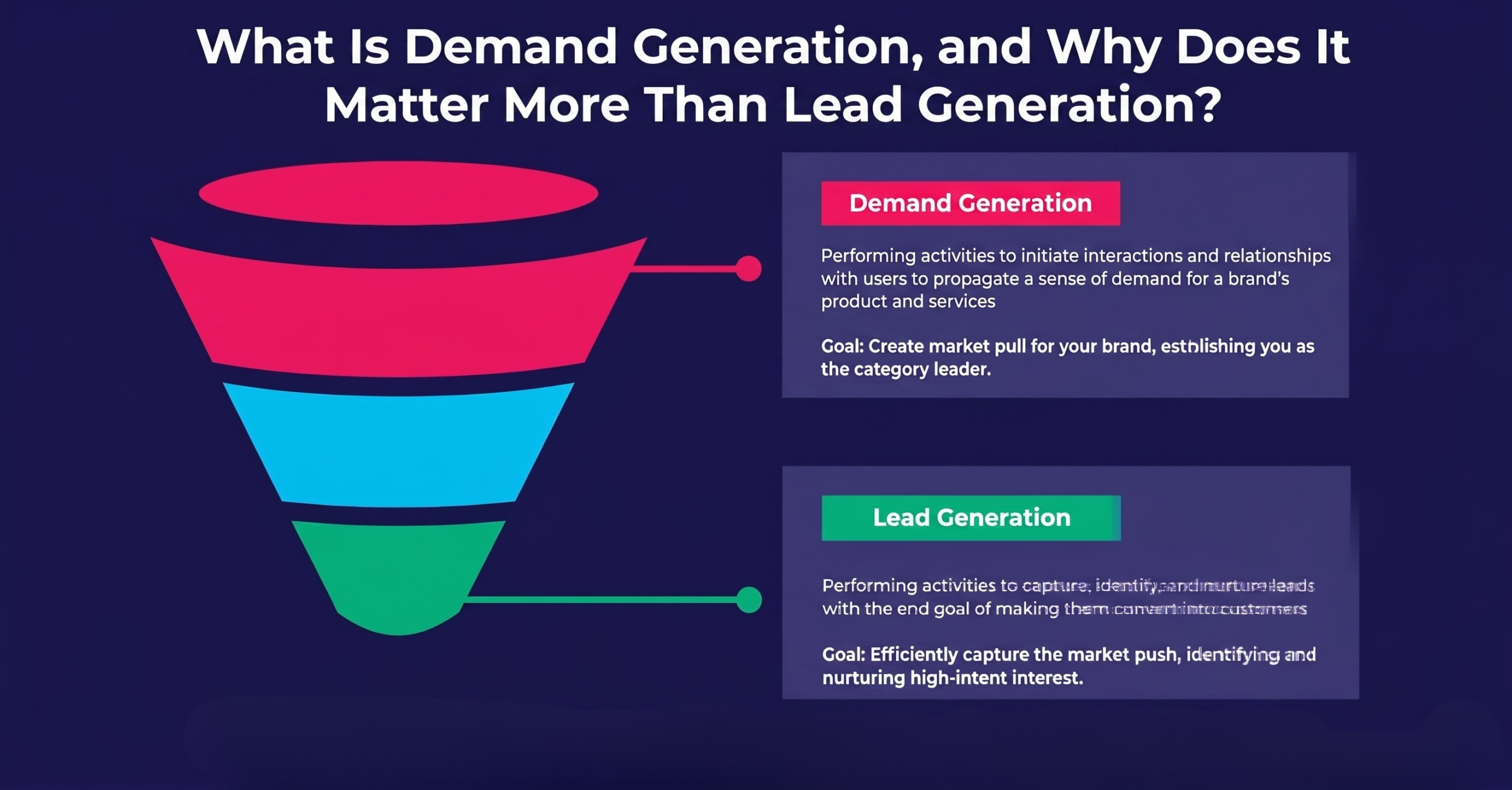
Lead generation captures existing demand. For B2B brands specifically, the paid-side execution layer that captures that demand efficiently is documented in our LinkedIn Ads bidding strategies guide.
Demand generation creates demand. It’s the work of educating a market, shifting how buyers think about a problem, establishing category leadership, and building the brand preference that makes your product the obvious choice when purchase intent finally materializes. It happens before the search. Before the RFP. Before the committee forms.
The practical implication: lead generation optimizes for this quarter’s pipeline. Demand generation builds next year. Navigating that trade-off at the start of every B2B engagement is one of the things our digital marketing services in Kolkata are explicitly scoped to handle.
Why the Shift Is Happening Now
Several converging forces are making demand generation impossible to ignore in 2026.
Buyer sophistication has increased dramatically. Self-service research, peer review platforms, and AI-powered discovery mean that buyers who do reach out to vendors already have strong pre-formed preferences. The phenomenon driving this shift – buyers researching invisibly before any lead form is filled – is covered in our dark funnel marketing analysis. If you weren’t part of their consideration set before they searched, you’re not getting evaluated, regardless of how well your lead capture is optimized.
The paid search efficiency curve is bending. High-intent keywords in most B2B categories have become expensive enough that the economics of pure lead-capture strategies are deteriorating. For B2B brands ready to invest in demand generation as a discipline rather than treating it as content marketing’s bigger sibling, our performance marketing team in Kolkata builds the full programme from category-level positioning through ad delivery.
AI-generated content has commoditized information. When every company can produce technically competent educational content at scale, the differentiation shifts to point of view, trust, and brand recognition all demand generation assets.
What a Demand Generation Strategy Actually Looks Like
Demand gen isn’t content marketing with a rebrand. It requires a distinct strategic architecture.
Category creation or category ownership is the highest-leverage demand gen move. Define the problem in your terms, name the category you’re building, and become the dominant educational voice within it. HubSpot didn’t win by capturing inbound marketing leads, they won by inventing and owning the concept of inbound marketing in the market’s mind.
Distributed content strategy matters more than SEO optimization alone. In 2026, demand is shaped on YouTube, in LinkedIn feeds, through podcast audiences, and via the AI-generated summaries that surface in ChatGPT and Perplexity. A demand gen strategy that only optimizes for Google is missing most of the surface area where buyers form opinions.
Original research and proprietary data are among the most durable demand gen assets a company can produce. Annual state-of-the-industry reports, benchmark studies, and survey-driven insights establish credibility, generate backlinks, and critically travel through dark funnel channels organically.
Integrating Demand Gen and Lead Gen Without Sacrificing Either
The goal isn’t to replace lead generation with demand generation, it’s to build a full-funnel system where demand gen feeds lead gen with higher-quality, higher-intent buyers.
Map your content strategy to buying stages with intentional gates. Top-of-funnel content, the educational, POV-driven material that builds demand, should be largely ungated to maximize distribution and trust. Mid-funnel content, where buyers are actively evaluating, is the appropriate place for lead capture because the exchange of value is proportionate.
Use product-led growth as a demand gen mechanism where the business model allows. A freemium tier, a free tool, or a deeply useful calculator creates product exposure that generates demand and captures intent simultaneously, without requiring a form fill before value delivery.
Measure demand gen differently. Share of voice, branded search volume trends, category keyword rankings, and pipeline quality metrics (average deal size, win rate, sales cycle length) are more appropriate demand gen measures than MQL volume. This requires an internal conversation about marketing’s measurement workflow, but it’s a necessary one.
The companies that invested in demand generation in 2022 and 2023 are closing deals today at lower acquisition costs than their lead-gen-only competitors. The companies investing in it now will have the same advantage in two years. Lead generation will always be part of the mix, but treating it as the strategy, rather than the harvest mechanism for a well-built demand engine, is a compounding mistake.
Frequently Asked Questions
How long does demand generation take to show results?
Realistically, 6–18 months before significant pipeline impact is visible. Early indicators include branded search growth, content engagement trends, and qualitative shifts in lead quality.
Is demand generation only for enterprise B2B?
No. SMB SaaS, professional services, and even e-commerce brands benefit from demand gen thinking, especially in competitive categories where acquisition costs are rising.
What budget split between demand gen and lead gen makes sense?
A common framework for scaling companies is 60/40 demand-to-lead, shifting toward 70/30 as the brand matures. Early-stage companies often need to invert this temporarily while building the initial pipeline.
Can paid advertising support demand generation?
Absolutely. LinkedIn Thought Leader Ads, YouTube pre-roll, and Meta awareness campaigns all function as paid demand gen, reaching buyers before intent and building familiarity at scale.