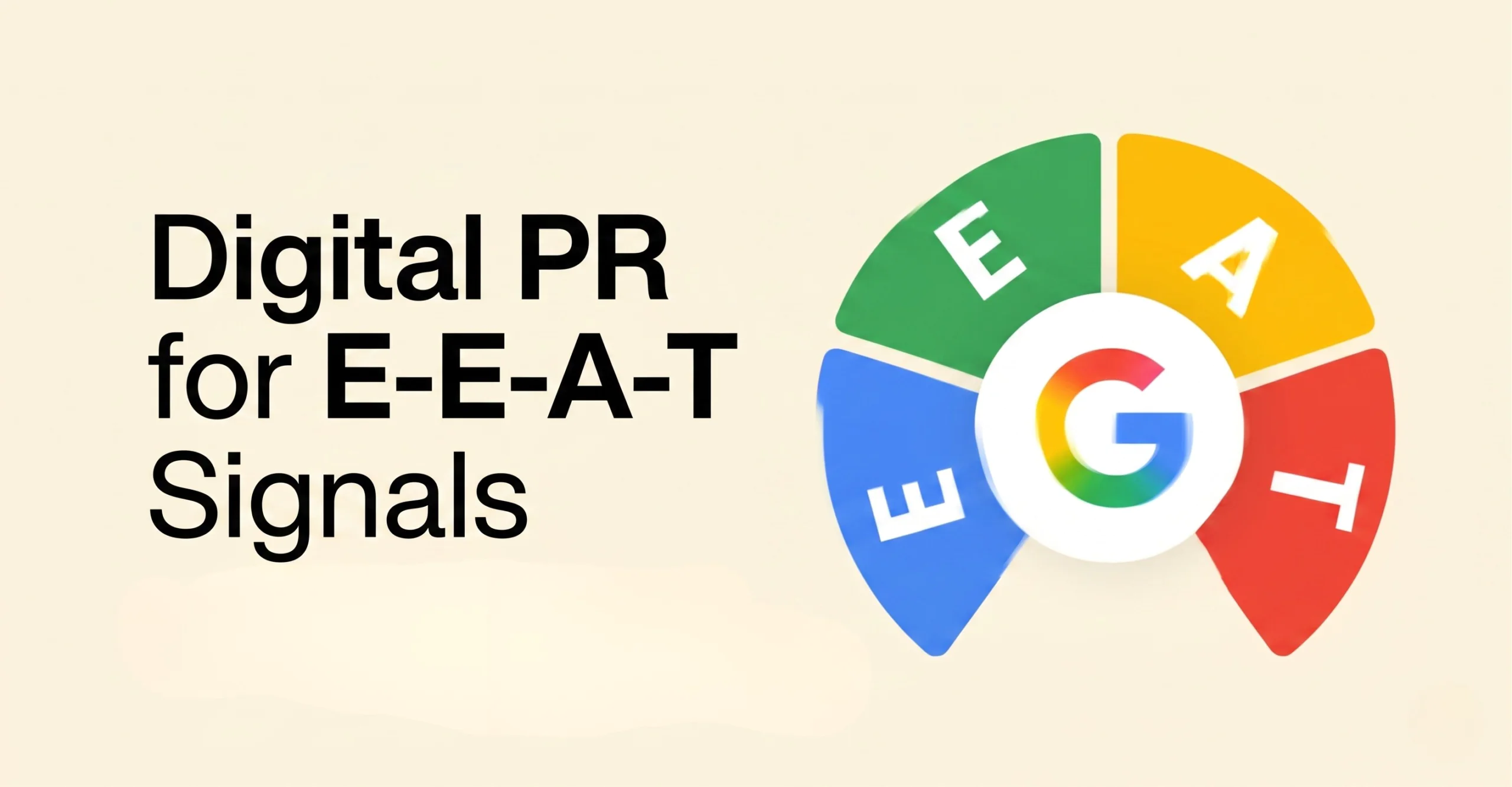
Search visibility is no longer determined solely by backlinks and on-page optimisation. Google’s Search Quality framework increasingly rewards brands that demonstrate Experience, Expertise, Authoritativeness, and Trustworthiness (E-E-A-T) through consistent signals across the web. As search engines evolve toward entity-based understanding and AI-powered search experiences, they rely less on isolated ranking factors and more on corroborated evidence that a business is credible within its industry.
This shift has elevated Digital PR for E-E-A-T signals from a traditional brand awareness activity to a strategic SEO initiative. Editorial mentions in reputable publications, expert contributions, industry reports, podcasts, and trusted third-party websites help search engines validate a brand’s authority beyond its own domain. These signals influence not only traditional search rankings but also how AI-powered search assistants interpret and recommend brands.
For marketers, this changes the objective of public relations. Instead of pursuing coverage solely for referral traffic or media exposure, Digital PR should create authoritative references that reinforce Google’s understanding of your expertise. This article explores how editorial mentions contribute to E-E-A-T, how modern search systems evaluate brand authority, and the practical Digital PR strategies you can implement to strengthen long-term search visibility.
Why Editorial Mentions Have Become a Core E-E-A-T Signal
For years, link building focused primarily on acquiring hyperlinks from high-authority websites. Today, Google’s understanding of brands extends well beyond hyperlinks. Search systems increasingly identify entities—people, businesses, products, and organizations, and evaluate how consistently these entities appear across trusted sources.
Editorial mentions contribute to this entity recognition because they are independent validations rather than self-published claims. When an industry publication references your company in an expert interview, research report, or feature article, it provides contextual evidence that external sources recognise your expertise.
This distinction matters because Google has consistently emphasised the importance of reputation signals generated outside a brand’s own website. Positive third-party references help reduce uncertainty about whether a business deserves visibility for competitive search queries.
For example, a cybersecurity company publishing dozens of blog articles about ransomware demonstrates topical expertise internally. However, if respected technology publications repeatedly quote its security researchers during major cyber incidents, search engines receive stronger external confirmation of that expertise.
The same principle applies across industries. Healthcare providers cited in medical journals, law firms quoted in legal publications, SaaS companies referenced in software comparisons, and eCommerce brands featured in buying guides all accumulate authority signals that reinforce their digital presence.
Importantly, not every editorial mention needs to include a backlink. Consistent brand mentions alongside relevant industry topics contribute to Google’s entity understanding, particularly when accompanied by clear contextual relationships.
As AI-generated search experiences continue expanding, editorial recognition becomes increasingly valuable because language models often rely on trusted web sources when identifying authoritative organizations.
Building Digital PR Campaigns That Generate Trust Instead of Temporary Attention
Many PR campaigns prioritise virality. While viral campaigns can generate significant traffic, they rarely create durable E-E-A-T signals unless they reinforce genuine expertise.
A more sustainable Digital PR strategy begins by identifying knowledge assets that demonstrate original value. These may include proprietary research, customer data trends, industry benchmarking reports, technical studies, executive commentary, or expert analysis of emerging market developments.
Original research consistently attracts editorial interest because journalists need credible sources supported by evidence. A recruitment software company publishing annual hiring trend data is more likely to earn citations than one distributing promotional press releases.
Another effective approach involves expert commentary. Reporters frequently seek informed opinions on breaking industry news. Establishing subject matter experts within your organisation allows journalists to reference your insights during relevant news cycles.
Digital marketers should also identify recurring editorial opportunities rather than isolated campaigns. Seasonal reports, annual industry surveys, recurring economic analyses, or quarterly consumer behaviour studies provide predictable opportunities for media coverage throughout the year.
Collaboration can further strengthen Digital PR initiatives. Joint research conducted with universities, trade associations, or technology partners often receives broader editorial coverage because multiple organisations contribute expertise.
Visual assets significantly improve media adoption. Interactive charts, proprietary infographics, downloadable datasets, and original illustrations simplify journalists’ work while increasing the likelihood of attribution.
Rather than measuring success by the number of published articles alone, evaluate whether each placement reinforces your topical authority within your target market.
Aligning Digital PR with Google’s Entity-Based Search Systems
Modern search engines increasingly organize information around entities instead of keywords. Rather than interpreting individual pages independently, Google connects organizations, individuals, products, services, and concepts into a broader knowledge graph.
This evolution changes how Digital PR should be executed.
Every editorial mention should consistently reinforce the same entity identity. Your company name, executive titles, product categories, industry specialisation, and geographic relevance should remain standardised across publications.
Inconsistent brand naming creates fragmented entity signals. For example, alternating between abbreviations, legal company names, and informal brand references may reduce Google’s confidence in connecting those mentions to a single organization.
Structured author profiles also contribute to stronger entity recognition. When executives regularly publish guest articles, appear on podcasts, participate in webinars, or contribute expert commentary, their personal authority strengthens the company’s overall reputation.
Schema markup complements Digital PR by helping search engines connect external mentions with your website. Organisation schema, Person schema, SameAs references, and author information reinforce these relationships.
Brands should also optimise their knowledge footprint beyond traditional media. Industry directories, association memberships, conference speaker profiles, award listings, and academic collaborations all contribute to additional entity validation.
The emergence of AI-powered search experiences further increases the importance of consistent entity signals. Large language models synthesise information from multiple trusted sources. Organisations mentioned repeatedly across reputable publications are more likely to appear in AI-generated responses because their authority has been independently corroborated.
Digital PR therefore becomes part of a broader entity optimisation strategy rather than an isolated communications activity.
Measuring the SEO Impact of Digital PR Beyond Backlinks
Traditional PR reporting often focuses on impressions, readership estimates, or advertising value equivalency. These metrics provide limited insight into how editorial mentions influence search performance.
Instead, marketers should evaluate Digital PR using search-oriented indicators that align with E-E-A-T development.
Brand search volume is one useful metric. Increased searches for your company name suggest growing market recognition, which often correlates with stronger authority signals.
Share of voice across authoritative publications provides another indicator. Rather than counting every mention equally, prioritise coverage within industry-leading websites that influence both users and search systems.
Monitor the growth of branded search queries alongside non-branded keyword rankings. Strong editorial visibility often improves rankings for adjacent informational topics because search engines gain greater confidence in the brand’s expertise.
Referral traffic remains valuable but should not become the primary success metric. Many high-impact editorial mentions generate minimal direct traffic while substantially strengthening long-term search authority.
Google Search Console can reveal improvements in impressions, click-through rates, and query diversity following sustained Digital PR campaigns.
Brand sentiment analysis adds another dimension. Positive editorial narratives contribute to trust, whereas inconsistent or negative coverage may weaken perceived authority despite generating visibility.
Marketers should also monitor entity recognition across AI search platforms. Ask AI assistants about your industry, leading companies, or subject matter experts to observe whether your brand increasingly appears within generated responses.
Digital PR success should therefore be measured as cumulative authority development rather than isolated campaign performance.
Future-Proofing Your Brand for AI Search and Zero-Click Discovery
Search behavior is shifting toward AI-generated answers, conversational interfaces, and zero-click experiences where users receive information without visiting multiple websites.
In this environment, trust becomes a ranking factor not only for Google Search but also for AI assistants selecting which sources to summarise.
Editorial mentions strengthen this trust because they provide independent evidence that your organization contributes meaningful expertise to its field.
Future Digital PR strategies should prioritise original knowledge creation over promotional storytelling. Brands publishing proprietary research, technical frameworks, educational resources, and expert insights are more likely to become reference sources for AI systems.
Executive visibility will also become increasingly important. Search engines evaluate not only organisations but also the credibility of individuals representing them. Encouraging leadership teams to contribute articles, conference presentations, interviews, and expert commentary expands the organisation’s authority footprint.
Community participation represents another emerging opportunity. Contributions to open-source projects, professional associations, standards committees, and educational initiatives generate authentic reputation signals that extend beyond traditional media coverage.
Digital marketers should also integrate PR data with SEO, content strategy, and analytics teams. Editorial insights can inform content planning, identify knowledge gaps, and reveal emerging industry conversations worth addressing before competitors.
The organisations that invest consistently in authoritative Digital PR today will likely become the brands most frequently cited by tomorrow’s AI-driven search experiences.
Closing Insights
Digital PR for E-E-A-T signals has evolved into a strategic discipline that connects brand reputation, SEO, and AI-driven discovery. Editorial mentions now serve a broader purpose than attracting publicity, they help search engines validate your expertise through independent, trustworthy sources. As Google continues refining entity-based search and AI-generated results, consistent references from respected publications strengthen your brand’s credibility across multiple discovery channels.
For marketers, the priority should be building campaigns around original research, expert commentary, and industry knowledge rather than promotional announcements. Success depends on creating assets that journalists, analysts, and publishers genuinely find valuable enough to reference. Measuring outcomes through brand authority, entity recognition, search visibility, and topical relevance provides a more accurate view of long-term impact than counting backlinks alone.
The future of digital marketing belongs to brands that earn trust rather than simply optimise for rankings. Editorial recognition, supported by consistent expertise and valuable contributions, will remain one of the strongest indicators that both search engines and AI systems use to determine which organisations deserve visibility.