- / Case-Study
- / Elite College of Engineering
Elitte College of Engineering
- CASE STUDY · HIGHER EDUCATION · HEADLESS WEB PLATFORM
One engineering college, dozens of people who need to publish, and an accreditation regime that never sleeps — rebuilt as a headless platform the college runs itself, with the admissions enquiry funnel wired straight into its CRM.
- CLIENT
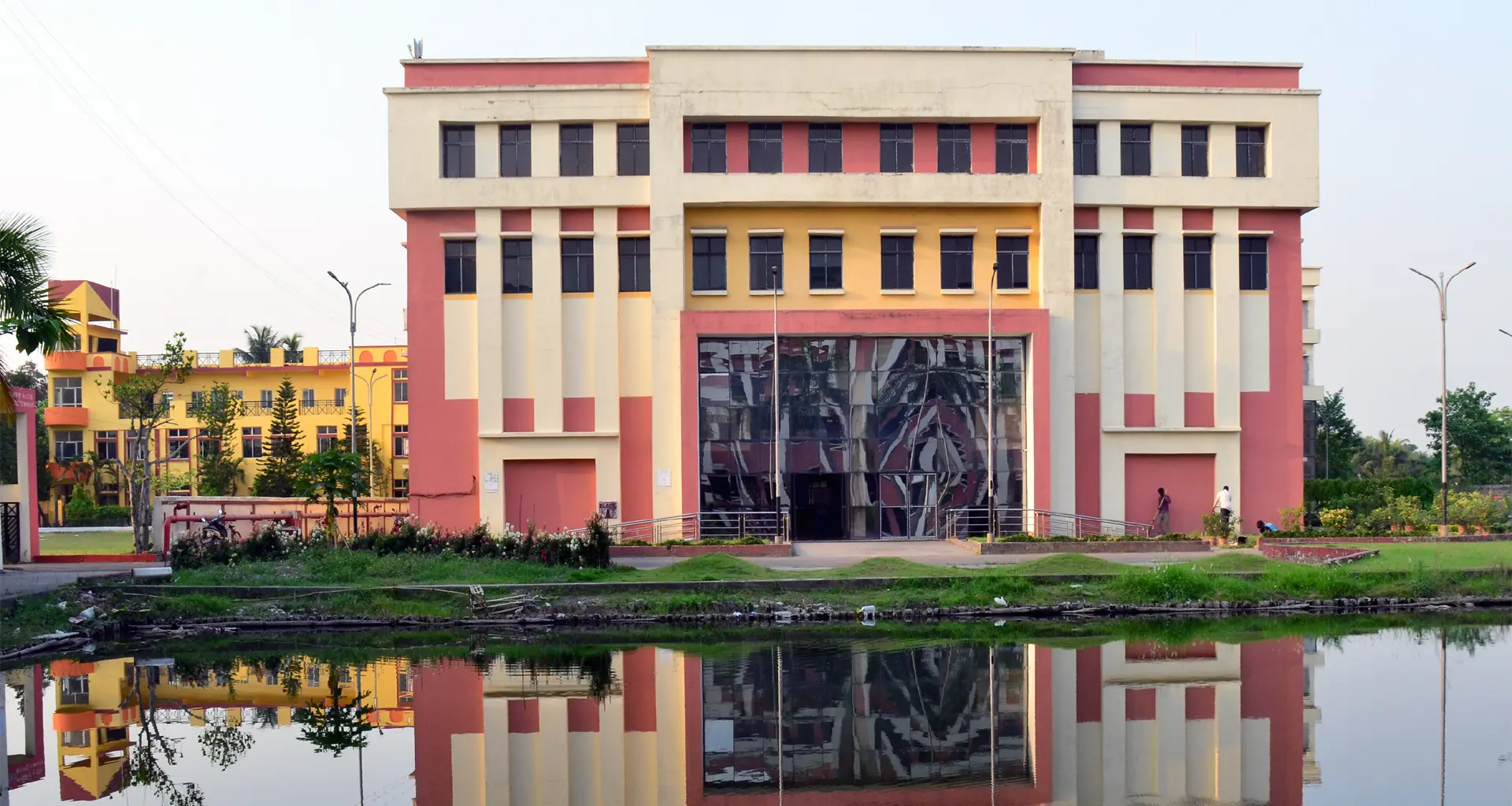
Elitte College of Engineering, Sodepur, Kolkata — an AICTE-approved private engineering
college founded in 2015 by the Pinnacle Educational Trust and affiliated to MAKAUT, West
Bengal.
- ENGAGEMENT
- SCOPE
deployment.
- PLATFORM
- The Brief
A college website looks like one website. Behind it are a dozen groups who all need to put things on the internet this week: the admissions office with a new prospectus, the placement cell with a campus-drive notice, the IQAC with a disclosure document, four engineering
departments with seminar announcements, and whoever is running the newsletter. Elitte had outgrown a site where any of that meant emailing a developer and waiting.
There was a second constraint that shapes every institutional site in India and rarely gets mentioned: mandatory disclosure. Approval letters, the governing body, anti-ragging committees, the internal complaints committee, NAAC and NBA and NIRF landing pages, the
organisational structure — all of it has to be present, current, and easy for an inspector or a parent to find. The information architecture isn’t a nice-to-have; it’s a compliance surface. So the brief came down to two things. Give the college a site its own staff can update daily
without breaking the front end, and make sure the public pages stay fast and findable while they do it.
- What we built
Transforming Campus Management with a Unified ERP Solution
We split the site in two. A Nuxt 3 front-end renders the public experience and talks to a Django REST API that holds the content. The two halves deploy separately and neither can take the other down a content edit is an API write, not a site rebuild, and a front-end release doesn’t touch the data.
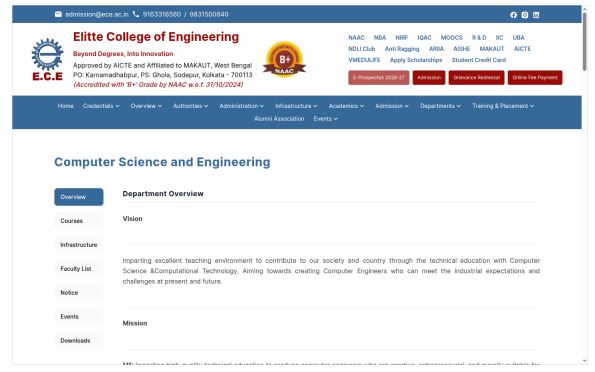
Everything that changes is a record behind that API. Each department page is an object with its own overview, course list, faculty roster, lab gallery, notices and downloads — the tabbed
layout a visitor sees is just that object rendered. Events are records with categories, so the same data drives the homepage highlights, the filterable events page, and the seminar list inside a single department. Notices and downloadable files are records too, tagged by department and type, which is why a departmental notice board and the institute-wide one are the same component pointed at different filters.
On top of that model we built the interface pieces a college actually uses. A scrolling news ticker for time-sensitive announcements. Image galleries with a lightbox for event coverage.
Placement data drawn as year-by-year charts, so the recruiter list updates by changing numbers rather than redrawing a graphic. Enquiry and application forms. Tables that page through hundreds of notices without a full reload.
On top of that model we built the interface pieces a college actually uses. A scrolling news ticker for time-sensitive announcements. Image galleries with a lightbox for event coverage.
Placement data drawn as year-by-year charts, so the recruiter list updates by changing numbers rather than redrawing a graphic. Enquiry and application forms. Tables that page through hundreds of notices without a full reload.
- RESEARCH
Findability and structured data
Splitting a site into an app and an API can quietly wreck its SEO if you let it, so we treated search as part of the build rather than a cleanup pass. Every route carries its own title, description and canonical URL through a dedicated SEO layout, so a department page, an event and the fee-structure page each describe themselves correctly to a crawler instead of inheriting a generic tag.
The homepage and key pages emit CollegeOrUniversity structured data — name, location, logo, official social profiles — so Google can represent the institution as an entity, not just a string of text. URLs are clean and readable, and the page titles are written for how people
actually search: “Top BTech College in Kolkata” rather than “Home”. None of this is glamorous. It’s the difference between a rebuild that holds its rankings and one that spends six months clawing them back.
- WHAT THE PLATFORM WE DELIVERED
- Editorial independence — departments, admissions, the placement cell and the IQAC all publish without a developer in the loop
- A structured content model where every department, event, notice, gallery and faculty profile is a reusable record, not a hand-built page.
- An SEO and structured-data foundation that survived the move to a headless architecture instead of being sacrificed to it.
- An admissions funnel with CRM hand-off and ad-conversion tracking, so marketing spend can be judged on enquiries rather than clicks.
- Static edge delivery that stays quick under load and independent scaling of the front end and the API.
- A site that has grown past 100+ routes while staying maintainable, because growth means adding content, not code.
- CREATIVES MADE BY US